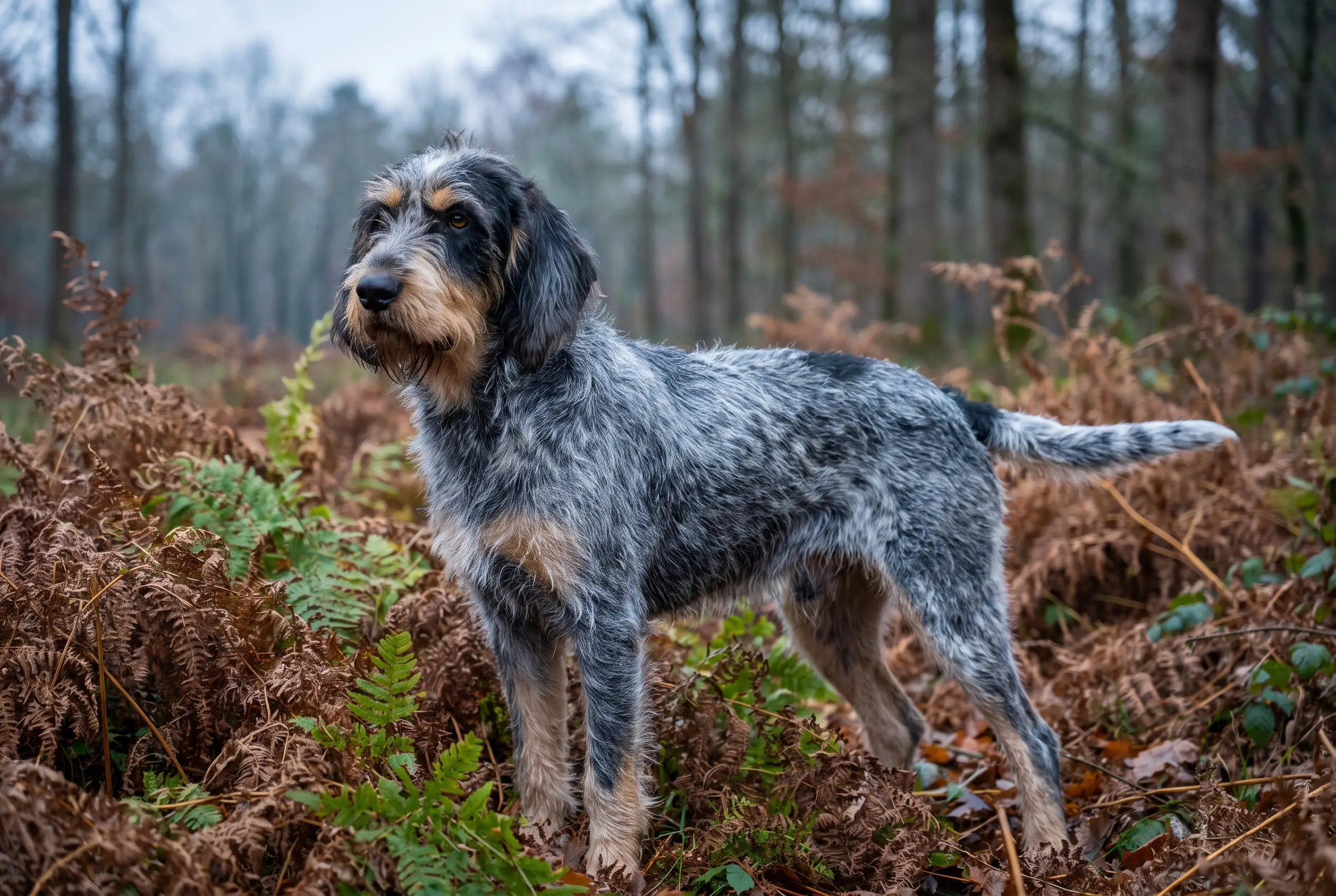
Griffon Bleu de Gascogne
A hare hound with a griffon's wire coat, and a temperament its own standard calls overwhelmingly agitated but affectionate.
Vital stats
| Size | Medium-large · 50–57 cm (dogs), 48–55 cm (bitches) |
| Weight | 20–30 kg — breed literature; the standard sets none |
| Life expectancy | 10–12 years — breed literature, not survey data |
| Energy | High — hunts hare on foot, tracks wild boar |
| Shedding | Low to moderate — wire coat, brushed weekly |
| Coat | Hard, rough, shaggy · black-and-white mottling reading slate blue |
| Group | Hound · Medium-sized Hounds (FCI №32, Group 6) |
| Origin | Gascony (Pyrenees), France |
| FCI group | 6 — Scent hounds and related breeds · FCI 32 |
Breed traits
Friendliness
Care
Mind
The Griffon Bleu de Gascogne by the numbers
The Griffon Bleu de Gascogne facts owners search for most — price, lifespan, weight, shedding and colours, in one place.
Less common, so expect a waitlist and some travel to a reputable breeder — which pushes the price up. Ongoing costs run high — more food, bigger doses at the vet, and pricier insurance.
We don't quote a single figure: the real price swings with breeder, region, bloodline and health testing — and a rescue costs a fraction of a breeder's litter. Adopting is almost always the cheapest route.
Temperament
The standard's behaviour clause reads: "Fine nose, good voice, intent in his way of hunting, but also full of keenness and enterprise. Temperament alert, even overwhelmingly agitated but yet affectionate." Overwhelmingly agitated is the standard's own choice of words, not an exaggeration — this is a hound that hunts loud and lives at volume, and it wants that energy matched at home. The affection is just as real: bred and worked in packs, it looks for company and does not do well shut away alone. Breed literature adds that it tends to hold back around strangers rather than crowd them, a reserve that early socialisation keeps from tipping into shyness — the standard itself disqualifies a dog that is either aggressive or overly shy.
Habits & quirks
The spot in the blaze
The standard notes its own quirk: the two black head patches stop short of meeting on top of the skull, leaving a white gap — and in the middle of that gap there's "frequently found a little black oval shaped spot, typical of the breed."
Four eyes, on paper
Tan spots above the eyebrows give what the standard calls a "quatroeuillé" effect, French for four-eyed — the same device used to describe eyebrow markings on black-and-tan breeds, layered here onto a blue-mottled coat.
From ten dogs to the biggest of the four
French club records count around ten Griffon Bleu de Gascogne left in 1977, across three bloodlines. Official French stud-book (LOF) figures for 2024 list 453 registered — more than the Petit Bleu de Gascogne (250), the Basset Bleu de Gascogne (144) or the Grand Bleu de Gascogne (122) that same year.
Timid docks points, overly shy disqualifies
The standard grades the same failure by degree: a "timid subject" is listed as a fault, while "aggressive or overly shy dogs" are disqualified outright. A working scenthound is expected to hold a steady, sociable temperament regardless of which direction it drifts.
Health
Breed literature calls the Griffon Bleu de Gascogne a generally sturdy hound with no single hereditary condition hanging over it, and there's no breed-wide health survey to argue with that. The honest watch-points are the ones any working scenthound shares: hip and elbow dysplasia worth asking a breeder about, and ear infections, since the low-set, curled ears fold shut over the canal and hold warmth and damp. Check and dry the ears regularly, especially after a wet day's work, and keep the dog lean and fit. Ask about the health of both parents rather than trusting the 10–12 years usually quoted, which rests on no real data.
Nutrition
| Exercise | The standard's own job description is hunting hare on foot behind the gun, with wild boar tracking as a sideline; breed literature puts daily exercise at 1.5–2 hours of real off-lead work, ideally with something to track. A walk alone doesn't use up what this hound was bred to do. |
| Grooming | The hard, rough, shaggy coat needs no trimming or hand-stripping — two or three brushings a week keep it in order, per breed literature. The low-set, curled ears fold shut against airflow and want a regular check. |
| Training | Channel the keenness the standard describes rather than fight it: short, consistent sessions with real rewards suit a hound built to work its nose. Early socialisation matters for the reserve it shows around strangers, and recall is worth the extra time given the strength of that nose. |
| Health | Breed literature calls it a generally sturdy breed with no single widely flagged hereditary condition, though hip and elbow dysplasia and ear infections from those low-set ears come up as watch-points, as with most working hounds. There's no breed-wide health survey behind the 10–12 years usually quoted. |
Feed a Griffon Bleu de Gascogne to its workload, which for a working hunting day and a quiet week are two different amounts. Weigh the meals, fold the training treats into the day's total, and aim for ribs you can feel under the wire coat. This is a lean, athletic hound built to run for hours, and it holds condition best kept that way: a fit dog moves and recovers better than a heavy one, and carries less strain into its joints over a long life.
Puppy guide
A Griffon Bleu de Gascogne puppy grows into a loud, driven pack hound, and the first year sets how easy that is to live with. Socialise him early and widely — this is a breed that holds back around strangers, and the standard itself faults a shy dog, so the work you put in now keeps that reserve from tipping into fear. Start recall before the nose takes over, keep the growing joints to gentle exercise rather than forced miles, and get him used to being part of the household, because a griffon bred and worked in packs does badly shut away alone.
Training
Work with the drive rather than against it. A Griffon Bleu de Gascogne is bright and biddable in short, rewarding sessions, but it is a scenthound first, and a hot trail will out-argue you every time once the nose is down. Put real, early investment into recall, keep the sessions varied and worth its while, and accept that this is a hound that hunts loud and lives loud — its own standard calls it overwhelmingly agitated. Give it a real outdoor job and the manners at home come easier.
Life expectancy
Griffon Bleus de Gascogne live 10–12 years — breed literature, not survey data. The Griffon Bleu de Gascogne is a hardy working hound, and the way you keep one sound is the way you keep it happy: real daily exercise with its nose in use, a lean weight, clean dry ears, and parents you asked honest questions about. There's no breed-wide survey behind the 10–12 years usually quoted, so a fit dog from tested, working lines is your best guide to a long one.
Similar breeds
Breeds with a similar build and background — worth a look if this one isn't quite the fit.
Breeds that look like this
Common questions
How is the Griffon Bleu de Gascogne different from the other Blue Gascony hounds?
Coat, mainly. Four FCI breeds share the same black-and-white mottled base out of Gascony: the Grand Bleu de Gascogne (FCI №22), the Petit Bleu de Gascogne (FCI №31), the short-legged Basset Bleu de Gascogne (FCI №35), and this one (FCI №32) — the only one with a hard, wire coat, from crossing a griffon onto the Bleu de Gascogne base. Strip the wire coat away and the mottling underneath is the same slate-blue ticking on all four.
Is it actually blue?
No — it's an optical effect. The coat is white thickly ticked with black, which reads blue-grey from a few feet off; the standard's own phrase is "entirely mottled (black and white) giving a slate blue effect." Close up it's just black flecking on white, plus the two black head patches and tan eyebrow spots that give the breed its four-eyed look.
Is it a rare breed?
It was nearly lost — French club records count around ten dogs from three bloodlines in 1977. It has recovered since: official French stud-book figures for 2024 list 453 Griffon Bleu de Gascogne registered, more than any of its three Blue Gascony cousins that year. It's still rarely seen outside hunting circles and almost never outside France, but within its own family it's no longer the smallest number.
Does the Griffon Bleu de Gascogne shed a lot?
Moderately. The Griffon Bleu de Gascogne sheds a fair amount, steadily through the year with heavier seasonal patches. A weekly brush keeps most of the loose hair off your floors and clothes.
Is the Griffon Bleu de Gascogne hypoallergenic?
Not really. No dog is truly hypoallergenic, and the Griffon Bleu de Gascogne's shedding coat releases plenty of the dander that sets off allergies. If someone at home is allergic, this isn't the easiest breed to live with — spend time around one first.
Is the Griffon Bleu de Gascogne good with children?
Generally yes. The Griffon Bleu de Gascogne is a friendly, people-loving breed that usually does well with children when raised and socialised well. As with any dog, teach children to be gentle and supervise around toddlers.
Is the Griffon Bleu de Gascogne easy to train?
They can be a challenge. The Griffon Bleu de Gascogne is intelligent but independent, and would rather make its own decisions than take orders. Reward-based training and patience work best; expect recall in particular to take time.