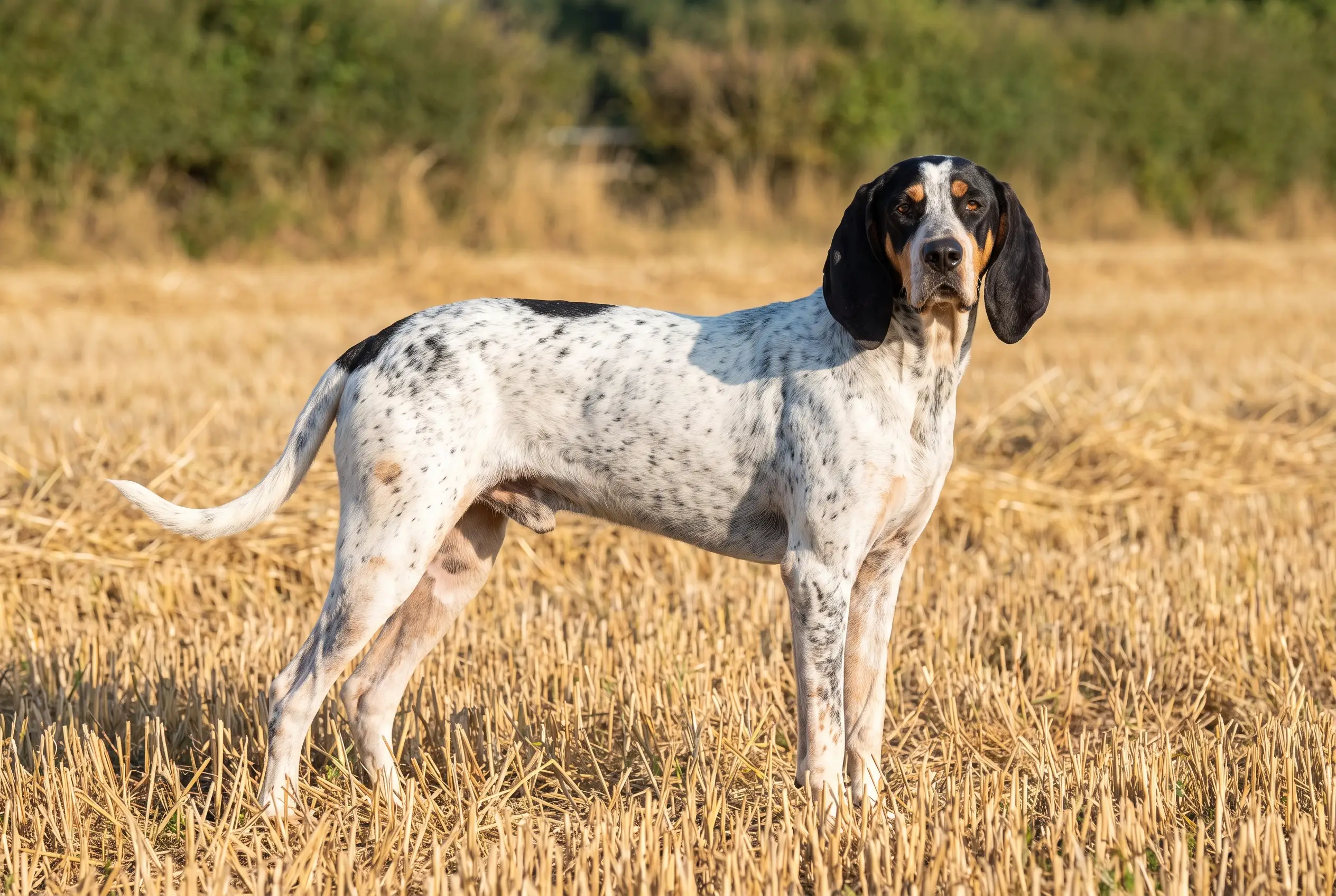
Gascon Saintongeois
A black-and-white pack hound built by crossing one dying breed into another, then losing the first.
Vital stats
| Size | Large · 65–72 cm (males), 62–68 cm (females) |
| Weight | 28–36 kg — breed literature; the standard sets none |
| Life expectancy | 10–12 years — breed literature, not survey data |
| Energy | High — built for a full day's hunting at pace |
| Shedding | Low — short, tight coat |
| Coat | Short and tight · white with black patches and tan quatroeillé markings |
| Group | Hound · Large-sized Scenthound (FCI №21, Group 6) |
| Origin | Gascony and Saintonge, southwestern France |
| FCI group | 6 — Scent hounds and related breeds · FCI 21 |
Breed traits
Friendliness
Care
Mind
The Gascon Saintongeois by the numbers
The Gascon Saintongeois facts owners search for most — price, lifespan, weight, shedding and colours, in one place.
Less common, so expect a waitlist and some travel to a reputable breeder — which pushes the price up. Ongoing costs run high — more food, bigger doses at the vet, and pricier insurance.
We don't quote a single figure: the real price swings with breeder, region, bloodline and health testing — and a rescue costs a fraction of a breeder's litter. Adopting is almost always the cheapest route.
Temperament
The standard's behaviour clause reads: pack hound par excellence, fine-nosed, wide-casting and endowed with a very sonorous voice. Joins the pack instinctively. Calm, affectionate and amenable to orders. That is a hunting résumé first and a house-pet description second. In the field it casts wide on its own initiative and announces what it finds; at home the same dog is described as calm and affectionate, not hyperactive or aloof. The instinct to fall in with a pack runs deep enough that a solitary Gascon Saintongeois is working against its own wiring — it does better with canine company, a job for its nose, and an owner who does not mind a very sonorous voice going off when the dog is excited.
Habits & quirks
Four eyes, on paper
Two tan marks sit above the superciliary arches, one over each eye, which the standard names a quatroeillé — four-eyed — look. Traces of the same tan show inside the ears and speckled down the legs, and some dogs carry a dead-leaf patch at the top of the thigh the standard calls the roe buck mark.
Ears past the nose
The standard asks for ears fine and curled, reaching at least the tip of the nose, set below the level of the eye and swept backward off the skull. Short or high-set ears are named faults in the same document.
A sabre, not a scimitar
The tail is strong at the set, tapers to the tip, reaches the point of the hock and is carried elegantly like a sabre — the standard's own comparison. A tail that deviates from that line is listed as a fault.
The rescue that finished the patient
Baron Joseph de Carayon-Latour bred the last three purebred Saintonge hounds into Baron de Ruble's Bleu de Gascogne stock to save the Saintonge line. The cross produced the Gascon Saintongeois so decisively that no pure Saintonge hound was left afterward — the standard states this plainly: causing the extinction of the Hound of Saintonge.
Health
There is no breed-wide health survey for the Gascon Saintongeois, so the honest advice is about type rather than a list of named conditions. It is a large, deep-chested hound, which makes two things worth knowing: ask breeders about hip screening, and learn the signs of bloat, because a suddenly swollen, hard belly in a deep-chested dog is an emergency. The long, low-set, folded ears are the routine job — they trap moisture and dirt and reward a regular check and clean, especially after a day with the nose to the ground. And because the population outside France is small, ask about pedigree depth too.
Nutrition
| Exercise | This is a pack hound bred to cover ground all day at a regular, effortless gait, not a dog for a lead-only walk around the block. Plan on well over an hour of real distance daily, ideally with scent work, tracking or hunting folded in — a bored Gascon Saintongeois with unspent nose-drive will find its own trail to follow. |
| Grooming | The short, tight coat needs only a weekly brush to stay tidy and sheds lightly. The ears are the actual chore: long, folded close to the head and set low, they trap moisture and dirt, so check and clean them regularly, especially after a day working scent close to the ground. |
| Training | The standard's own word is amenable, and breed literature adds that it responds best to a calm, consistent hand rather than a heavy one. Because the instinct to fall in with a pack and follow a scent runs so deep, recall training started early and kept up throughout life matters more here than in most breeds — a nose this good will win the argument if you let it start one. |
| Health | The standard is silent on health, and there is no breed-wide survey behind the life-expectancy figure quoted above. As a large, deep-chested hound it is sensible to ask breeders about hip screening and to know the signs of bloat; breed literature reports no other widely flagged issue, but the population outside France is small enough that pedigree depth is worth asking about too. |
Feed to the work the dog actually does: a Gascon Saintongeois running scent all day and one having a quiet week are not on the same ration, so adjust with the season and weigh rather than guess. Keep it lean — a working hound carries its weight better light — and let the deep chest shape how you feed it, with smaller meals and a calm hour rather than a hard run straight after eating. Count any training or trail treats in the day's total.
Puppy guide
A Gascon Saintongeois puppy grows into a big, athletic hound, so keep early exercise low-impact and let the body come along at its own pace before the long days start. Start the recall the day it comes home and keep at it — this is a nose that will one day want to leave on a scent, and the habit has to be older than the instinct. Socialise widely, give it company (the breed is built to live in a pack and does poorly alone), and get it used to having those big ears handled and checked early, so a lifetime of ear care is routine rather than a fight.
Training
The standard calls the breed amenable, and it responds to a calm, consistent hand far better than a heavy one. The one lesson to start early and never stop is recall: the instinct to put its nose down and follow a line runs deep, and a scenthound this good will win that argument if you give it the chance to start one. Fold real nose work into the routine — tracking, scent games, a proper job — so the drive has a legal outlet and does not go looking for its own.
Life expectancy
Gascon Saintongeois live 10–12 years — breed literature, not survey data. The life expectancy quoted for the Gascon Saintongeois comes from breed literature rather than survey data. You give the dog its best shot at a long, sound life the ordinary way: lean weight, hips asked about before you buy, ears kept clean, and enough real work to keep a hunting hound right in body and mind.
Similar breeds
Breeds with a similar build and background — worth a look if this one isn't quite the fit.
Breeds that look like this
Common questions
Is the Gascon Saintongeois the same dog as the Bleu de Gascogne?
Related, not the same. The Gascon Saintongeois was made in the 1840s by crossing the last Saintonge hounds into Bleu de Gascogne stock, and it carries FCI standard No. 21. The Grand Bleu de Gascogne — the older, blue-mottled hound that supplied that stock — is its own breed under FCI standard No. 22, still bred and shown separately today. Same Gascon root, two different standards, two different dogs since the 19th century.
What's the difference between the Grand and Petit Gascon Saintongeois?
Size, mostly, and they share one FCI number rather than two. The Grand stands 65–72 cm and works big game or hare, alone or with the pack; the Petit — sometimes called the Petit Chien Bleu de Gascogne in older literature — stands 56–62 cm and was bred down from Grand litters in the mid-20th century specifically for hare. That single-standard arrangement is unusual: the wider Bleu de Gascogne family splits its sizes into separate breeds and separate FCI numbers — Grand No. 22, Petit No. 31, Griffon No. 32, Basset No. 35 — while both Gascon Saintongeois sizes stay under No. 21.
Are they good family dogs?
The standard calls the breed calm, affectionate and amenable to orders, and that holds up at home. The trade-off is the job it was built for: a very sonorous voice that carries when the dog is excited, a nose that wants real daily work, and a pack instinct that makes it happiest with company, canine or otherwise. It suits an active household with space and patience for the voice more than an apartment.
Does the Gascon Saintongeois shed a lot?
Not much. The Gascon Saintongeois is a low-shedding breed, so loose hair around the home stays minimal. It still needs regular grooming, but you won't be fighting drifts of fur.
Is the Gascon Saintongeois hypoallergenic?
No dog is truly hypoallergenic, but the Gascon Saintongeois comes closer than most: its low-shedding coat releases less of the dander that triggers allergies. Many allergy sufferers manage well with this breed, but spend time around one before committing.
Is the Gascon Saintongeois easy to train?
Reasonably. The Gascon Saintongeois is trainable with consistency and rewards, though it isn't the quickest study. Keep sessions short and positive, and be patient with the basics like recall.