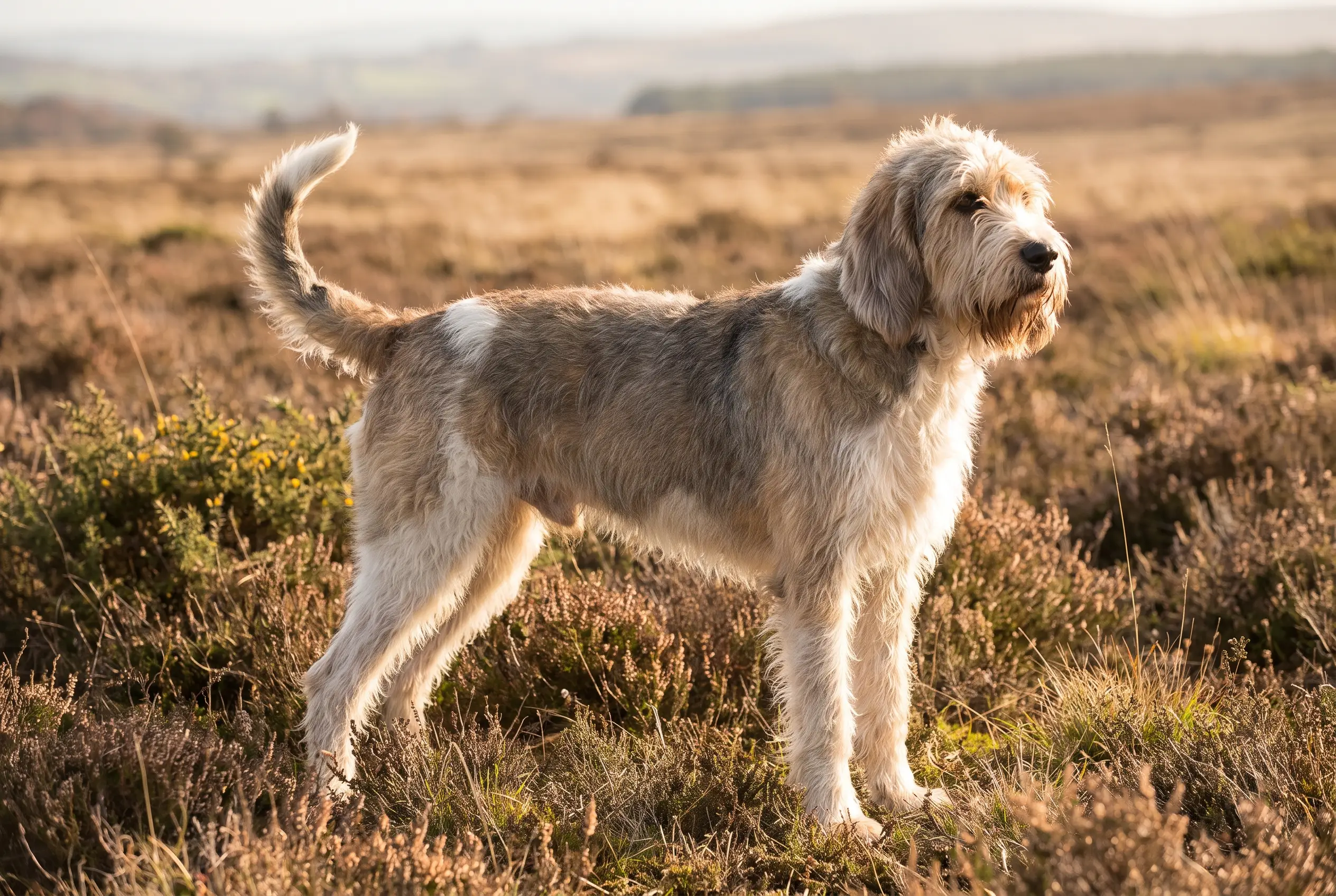
Grand Griffon Vendéen
The tall, straight-legged original the three shorter Vendée griffons were all bred down from.
Vital stats
| Size | Large · 62–68 cm (dogs), 60–65 cm (bitches) |
| Weight | 30–35 kg — breed literature; the standard sets none |
| Life expectancy | 12–14 years — breed literature, not survey data |
| Energy | High — daily exercise across real territory |
| Shedding | Moderate — long, dense coat, weekly brush |
| Coat | Long, harsh, sometimes bushy · never smooth or woolly |
| Group | Scenthound · Large-sized Hounds (FCI №282, Group 6) |
| Origin | Vendée, France |
| FCI group | 6 — Scent hounds and related breeds · FCI 282 |
Breed traits
Friendliness
Care
Mind
The Grand Griffon Vendéen by the numbers
The Grand Griffon Vendéen facts owners search for most — price, lifespan, weight, shedding and colours, in one place.
Less common, so expect a waitlist and some travel to a reputable breeder — which pushes the price up. Ongoing costs run high — more food, bigger doses at the vet, and pricier insurance. Its coat also needs a professional groom every few weeks — a real line in the budget.
We don't quote a single figure: the real price swings with breeder, region, bloodline and health testing — and a rescue costs a fraction of a breeder's litter. Adopting is almost always the cheapest route.
Temperament
The standard splits its character into two clauses, and both matter. Behaviour: "fine nose, has a beautiful voice; assiduous on the track, does not refuse thorny undergrowth, needs large territories." Temperament: "docile, but wilful and passionate, needs to be kept well in hand." Read together, that describes a dog built to hunt for hours over difficult ground while still answering to the huntsman running the pack — not a dog designed for quiet apartment life. Breed literature adds a dominant, strong-willed streak alongside real gentleness at home, which tracks with a standard asking for both drive and control in the same animal.
Habits & quirks
A whole vocabulary of colour
The standard lists eight separate colour combinations, from black with white spotting through fawn with a black mantle to pale fawn with a black overlay — and four of the fawn patterns carry old hunting-country names: hare colour, wolf colour, badger colour, wild boar colour.
Hunts two different ways
It works stag, roe deer, wild boar and fox either in a full baying pack or alone on a lead as a limer — a dog used to pick up and confirm a cold trail before the pack is released to run it.
Ears built to a measurement
The standard doesn't just ask for long ears; it specifies that, drawn forward, they must reach beyond the end of the nose — a checkable trait, not a general impression.
Marbled skin under the coat
In tricolour dogs the standard notes the skin itself is often marbled, a detail invisible until you actually part the coat and look.
Health
Breed literature describes the Grand Griffon Vendéen as generally sturdy, with one standing chore: the low-set, hair-covered ears need regular checks and cleaning to head off infection. There's no breed-wide health survey behind that, and the population is small enough that most puppies still come from working hunt kennels — so your best move is a breeder who works their dogs and talks straight about the lines.
Nutrition
| Exercise | This is a pack hound built to work stag and boar over hard ground for hours; the standard's own phrase is that it "needs large territories." A securely fenced large property or genuine daily access to open country suits it far better than a flat and a lead-only routine. |
| Grooming | The coat is long without exaggeration, sometimes bushy and harsh, over a dense undercoat — brush weekly to stop matting, more often through a heavy moult, and keep the pendulous, moustached lips clean after meals. |
| Training | The standard states its own trade-off: "docile, but wilful and passionate, needs to be kept well in hand." Start early, stay consistent, and expect a dog that treats a strong scent as outranking a recall command — for centuries of breeding, that was the correct call. |
| Health | Breed literature describes it as generally sturdy, with the low-set, hair-covered ears needing regular checks against infection; there is no breed-wide health survey behind that claim, and the population is small enough that most puppies still come from working hunt kennels rather than volume breeders. |
This is a big, hard-working pack hound that 'needs large territories,' in the standard's own words, so feed to that real workload and adjust as the season and the work change. Keep it lean under the long coat, count treats in the day's total, and wipe those pendulous, moustached lips clean after meals so nothing sours in the beard.
Puppy guide
A Grand Griffon Vendéen pup is docile but already wilful and passionate, so start early and stay consistent — the habits you set now are the ones you'll live with. Socialize it well as the pack dog it is, begin recall knowing a strong scent will always compete with you, and give it real space and a secure fence rather than a flat and a lead. This is a demanding breed to raise; go in with your eyes open.
Training
The standard states the trade-off itself: 'docile, but wilful and passionate, needs to be kept well in hand.' Start young, keep it consistent, and expect a dog that treats a strong scent as outranking your recall — for centuries of breeding, that was exactly the right call. Calm, firm, patient handling gets you a long way; nagging gets you nowhere.
Life expectancy
Grand Griffon Vendéens live 12–14 years — breed literature, not survey data. The usual figure rests on breed literature, not a survey, so treat it as a guide. A generally sturdy hound stays sound the ordinary way: lean weight, ears checked and cleaned, genuine daily exercise across real ground, and a pup from a working breeder who's honest about health.
Similar breeds
Breeds with a similar build and background — worth a look if this one isn't quite the fit.
Breeds that look like this
Common questions
Is the Grand Griffon Vendéen the same as the Grand Basset Griffon Vendéen?
No, and the names invite exactly this mix-up. The Grand Griffon Vendéen (FCI No. 282) is the tall, straight-legged original, 62–68 cm at the withers. The Grand Basset Griffon Vendéen (FCI No. 33) is a basset: bred down to short legs, standing roughly 39–44 cm. "Grand" describes each dog's size within its own type, not a comparison between the two — a Grand Basset is not a big Petit Basset, it's a basset-sized version of this larger hound.
How many Vendée griffon breeds are there, and how do they relate?
Four, and all descend from this one. The Grand Griffon Vendéen came first, developed from old French hound lines including the 16th-century "Greffier." Breeders then selected for shorter legs and smaller size to make hunting easier on foot: the Briquet Griffon Vendéen (FCI No. 19, mid-sized, still straight-legged), the Grand Basset Griffon Vendéen (FCI No. 33, the larger basset) and the Petit Basset Griffon Vendéen (FCI No. 67, the smaller basset). Only the Grand Griffon Vendéen kept the original long legs.
Is a Grand Griffon Vendéen a good pet?
For the right home, yes — but it's a specialist's dog before it's a companion. It's rare outside French hunting circles, needs real daily exercise across real space, and the standard is direct that it stays "wilful and passionate" even when docile. Households ready for a demanding scenthound with a loud voice and a strong independent streak do well with it; anyone hoping for a low-key house dog should look at one of its basset cousins instead.
Does the Grand Griffon Vendéen shed a lot?
Moderately. The Grand Griffon Vendéen sheds a fair amount, steadily through the year with heavier seasonal patches. A weekly brush keeps most of the loose hair off your floors and clothes.
Is the Grand Griffon Vendéen hypoallergenic?
Not really. No dog is truly hypoallergenic, and the Grand Griffon Vendéen's shedding coat releases plenty of the dander that sets off allergies. If someone at home is allergic, this isn't the easiest breed to live with — spend time around one first.
Is the Grand Griffon Vendéen good with children?
Generally yes. The Grand Griffon Vendéen is a friendly, people-loving breed that usually does well with children when raised and socialised well. As with any dog, teach children to be gentle and supervise around toddlers.
Is the Grand Griffon Vendéen easy to train?
Reasonably. The Grand Griffon Vendéen is trainable with consistency and rewards, though it isn't the quickest study. Keep sessions short and positive, and be patient with the basics like recall.