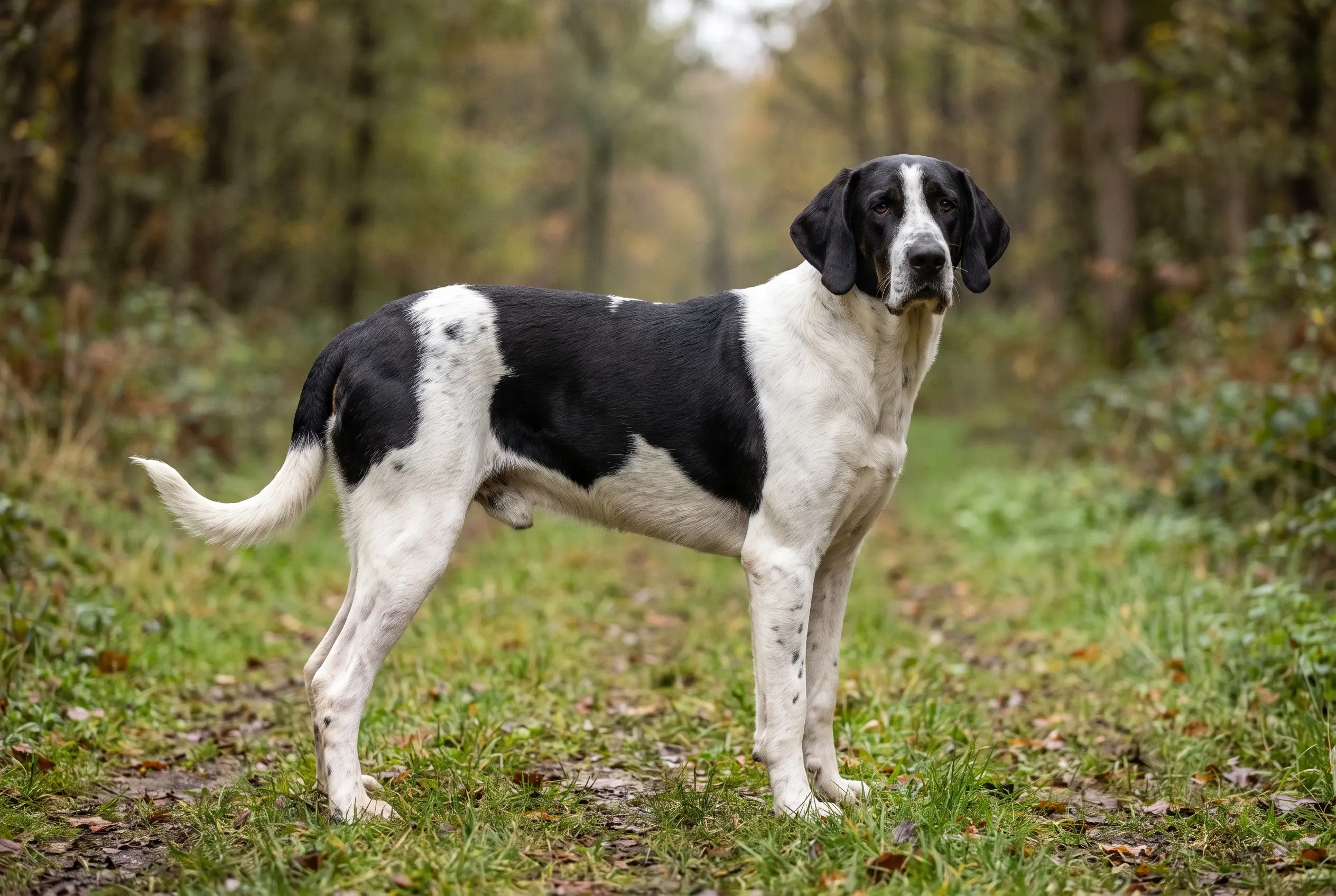
Grand Anglo-Français Blanc et Noir
A white-and-black pack hound born from crossing the old Saintongeois with the English Foxhound, still running in France's biggest stag hunts.
Vital stats
| Size | Large · 65–72 cm (males), 62–68 cm (females) |
| Weight | 30–35 kg — breed literature; the standard sets none |
| Life expectancy | 10–12 years — breed literature, not survey data |
| Energy | High — built for full-day pack hunts on big game |
| Shedding | Low — short, dense coat |
| Coat | Short, dense · obligatory white and black, black mantle with tan facial markings |
| Group | Hound · Large-sized Hounds (FCI №323, Group 6) |
| Origin | France |
| FCI group | 6 — Scent hounds and related breeds · FCI 323 |
Breed traits
Friendliness
Care
Mind
The Grand Anglo-Français Blanc et Noir by the numbers
The Grand Anglo-Français Blanc et Noir facts owners search for most — price, lifespan, weight, shedding and colours, in one place.
Less common, so expect a waitlist and some travel to a reputable breeder — which pushes the price up. Ongoing costs run high — more food, bigger doses at the vet, and pricier insurance.
We don't quote a single figure: the real price swings with breeder, region, bloodline and health testing — and a rescue costs a fraction of a breeder's litter. Adopting is almost always the cheapest route.
Temperament
The standard's behaviour clause is short and specific: excels in hunting stag and deer on damp or bushy terrain, and is a friendly dog, close to humans and easy to manage in the kennels. That is a working description first — written for a hound that lives among dozens of packmates in a hunt kennel, not a single household. Breed literature is more direct about what that means day to day: reserved and aloof with strangers, confident with other dogs, and not generally recommended around young children. It is bred to run, nose down, for hours on rough or wet ground, and a hound with that job description does not switch easily into a sit-by-the-fire life.
Habits & quirks
A cross that kept the bone
The standard's own general-appearance clause credits the breed's strong bone to its Gascon-Saintongeois origins — the lineage behind the Gascon Saintongeois (FCI No. 21) and the Grand Bleu de Gascogne (FCI No. 22) that supplied it. The breed itself descends from the Bâtard Anglo-Saintongeois, a mid-19th-century cross of the old Saintongeois hound with the English Foxhound.
White and black, no exceptions
The standard calls the colour obligatory white and black — a black mantle with black or bluish speckles, a pale tan dot above each eye, tan on the cheeks, and often the same "roebuck mark" on the thigh seen in its Gascon-Saintongeois cousins. A tricolour coat is a disqualifying fault, which is what actually separates this dog from its closest relative, the Grand Anglo-Français Tricolore.
Ears measured in fingers
The standard gives an exact test: pulled forward, the ears should not reach further than two fingers before the base of the nose leather. Ears that are distinctly curled or too long count as a severe fault.
A small, working population
The standard states its own numbers: roughly 2,000 dogs, about 200 births a year, working in more than twenty deer packs and one stag hunt, almost all of it in France. This is a hunting-kennel breed, not a breeder-waitlist one.
Health
The standard says nothing about health, and there's no breed-wide survey behind the 10–12 years usually quoted, so treat the figure as breed literature rather than fact. What that literature does flag is worth asking a breeder about directly: hip dysplasia, and ear infections in those medium, curling ears, which trap moisture after a day working wet or overgrown ground and want checking and cleaning regularly. Beyond that it's generally reported as a sound, working-fit hound — but with a small population bred almost entirely for the hunt, ask about the lines behind a pup rather than assuming a documented health scheme.
Nutrition
| Exercise | This is a pack hound built to run stag and deer over damp or bushy ground for a full day's hunt, not a dog exercised by a lead walk. It needs hours of real running most days, ideally with a pack or on a genuine scent trail; a Grand Anglo-Français Blanc et Noir kept as a solitary pet without a serious daily outlet is being asked to live against its own design. |
| Grooming | The short, dense coat needs only a weekly brush and sheds lightly. The medium, curling ears deserve a regular check and clean, especially after a day working wet or overgrown terrain. |
| Training | The standard calls it easy to manage in the kennels, which describes a hound that takes direction well among a handler and a pack — not necessarily a dog that settles into an ordinary household routine. Breed literature adds that it tends to be reserved with strangers and is not generally recommended around young children, so anyone taking one on outside a hunting kennel should start socialisation early and expect an independent, nose-led mind. |
| Health | The standard is silent on health, and there is no breed-wide survey behind the usually quoted 10–12 years. Breed literature flags hip dysplasia and ear infections as the main things to ask breeders about; beyond that it is generally reported as a sound, working-fit breed. |
This is a big pack hound built to run stag and deer for a full day's hunt, so feed it to the work in front of it — a dog hunting hard through the season burns far more than one resting between meets, and the bowl should follow that. Keep it lean and hard, with ribs you can feel under the short coat; a scenthound carries condition better than fat. And because it's a large, deep-chested dog, split the day's food across two meals and keep hard running well clear of feeding time — the standard everyday caution for a hound of this frame.
How much should I feed a Grand Anglo-Français Blanc et Noir? →
Puppy guide
Almost every Grand Anglo-Français Blanc et Noir is raised in a hunt kennel among packmates, so a pup taken on outside that world needs a deliberate plan. Socialise it early and widely, because the breed tends to be reserved with strangers and is generally not recommended around young children — early exposure is what keeps that reserve from setting hard. Build recall from the start and hold it firmly, since this is a nose-led, independent hound that will follow a scent past a command it hasn't solidly learned, and keep those curling ears clean young so handling them is routine.
Training
The standard calls it easy to manage in the kennels, which describes a hound that takes direction well among a handler and a pack — not a dog that slides naturally into an ordinary household routine. Expect an independent, nose-led mind: build recall first and keep it consistent against the pull of a trail, because that pull is the whole point of the breed. Keep sessions positive and give the nose real work — tracking, scent games, the hunt itself — and start socialising early if the dog is living anywhere other than a working kennel.
Life expectancy
Grand Anglo-Français Blanc et Noir hounds live 10–12 years — breed literature, not survey data. The 10–12 year figure comes from breed literature rather than any survey, so read it as a guide, not a guarantee. What keeps a big working scenthound sound is straightforward: lean weight, clean ears, hips worth asking a breeder about, and a life with the hours of real running it was built for. Give it the work and the exercise it needs and it holds condition for a long time.
Similar breeds
Breeds with a similar build and background — worth a look if this one isn't quite the fit.
Breeds that look like this
Common questions
Does "Grand" mean it's a bigger dog?
No — it marks the job, not the size. "Grand" means big game: the standard's own utilization line reads pack hound for big game, and this dog hunts stag and deer. Its smaller relative, the Anglo-Français de Petite Vénerie (FCI No. 325), is built at medium-hound size for hare and fox — a different job, not a puppy-sized version of this one.
What's the difference between this and the Grand Anglo-Français Tricolore or Blanc et Orange?
Colour, and colour alone — the three share one build, size and standard's worth of behaviour, split across three separate FCI numbers. This one is obligatory white and black (FCI No. 323); the Grand Anglo-Français Tricolore (No. 322) adds tan to a black-and-white base; the Grand Anglo-Français Blanc et Orange (No. 324) swaps the black for orange. A judge disqualifies a tricolour coat on this dog exactly as it would disqualify white-and-black on the Tricolore.
Is this the same as the Français Blanc et Noir?
Related in name and colour, not in blood. The Français Blanc et Noir (FCI No. 220) and its tricolour and white-and-orange siblings (No. 219 and No. 316) are the pure French line — their own standard disqualifies any apparent trace of English hound blood. The Grand Anglo-Français Blanc et Noir carries that blood on purpose: it descends from the Bâtard Anglo-Saintongeois, the mid-19th-century cross of French scenthound and English Foxhound that the "Anglo" in its name announces.
Does the Grand Anglo-Français Blanc et Noir shed a lot?
Not much. The Grand Anglo-Français Blanc et Noir is a low-shedding breed, so loose hair around the home stays minimal. It still needs regular grooming, but you won't be fighting drifts of fur.
Is the Grand Anglo-Français Blanc et Noir hypoallergenic?
No dog is truly hypoallergenic, but the Grand Anglo-Français Blanc et Noir comes closer than most: its low-shedding coat releases less of the dander that triggers allergies. Many allergy sufferers manage well with this breed, but spend time around one before committing.
Is the Grand Anglo-Français Blanc et Noir good with children?
They can be. The Grand Anglo-Français Blanc et Noir is reasonably sociable and can be good with children in the right home, especially when socialised early. Supervise around young kids and teach dog and child to respect each other.
Is the Grand Anglo-Français Blanc et Noir easy to train?
Reasonably. The Grand Anglo-Français Blanc et Noir is trainable with consistency and rewards, though it isn't the quickest study. Keep sessions short and positive, and be patient with the basics like recall.