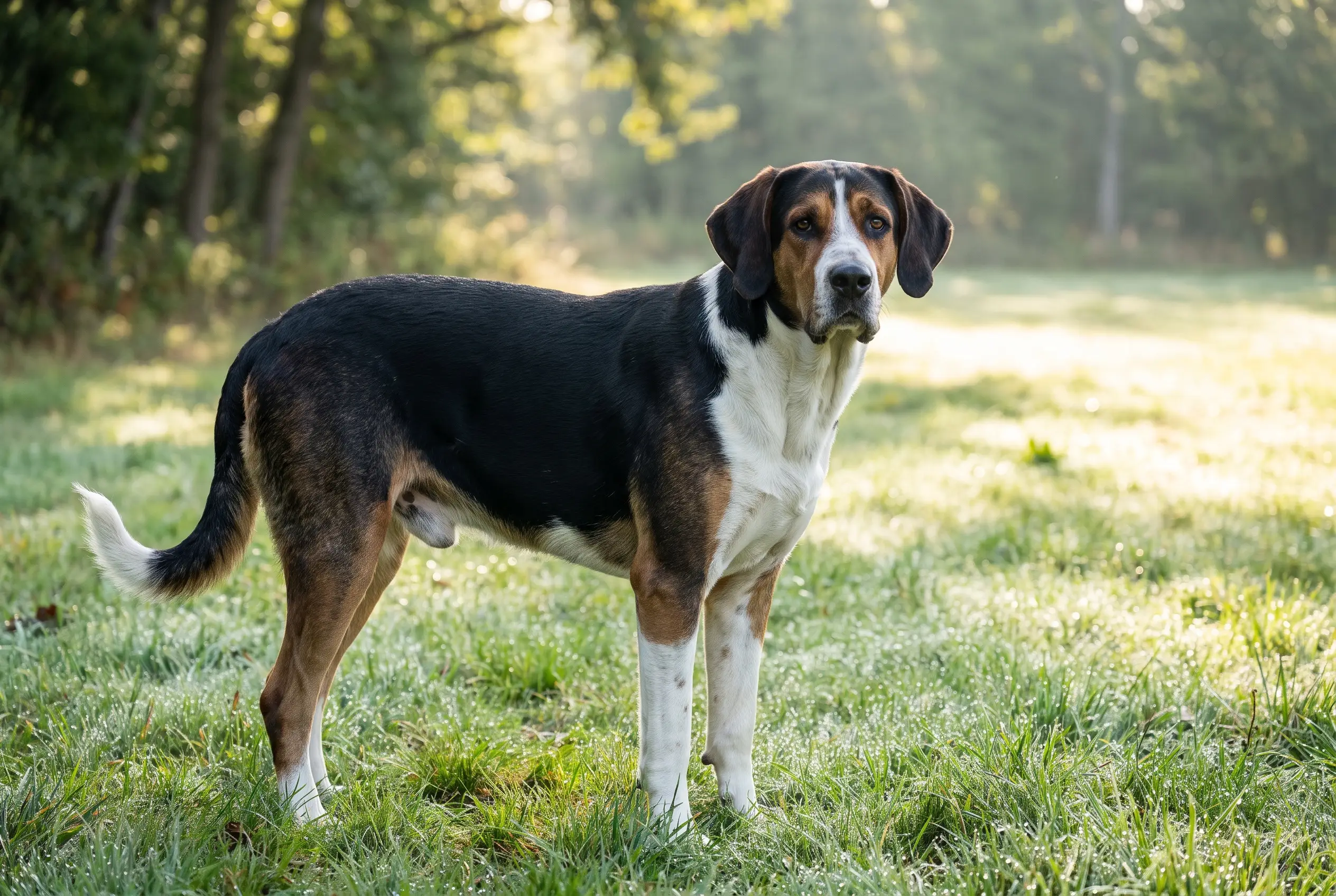
Grand Anglo-Français Tricolore
French nose, English gallop, bred to run big game — not to keep a single owner company.
Vital stats
| Size | Large · 60–70 cm at the withers |
| Weight | 30–35 kg — breed literature; the standard sets none |
| Life expectancy | 10–14 years — breed literature, not survey data |
| Energy | Very high — built to gallop with the pack all day |
| Shedding | Low — short, strong coat |
| Coat | Short, more or less strong · tricolour: black blanket or patches on white, bright or copper tan |
| Group | Hound · Large-sized Scenthound (FCI №322, Group 6) |
| Origin | France |
| FCI group | 6 — Scent hounds and related breeds · FCI 322 |
Breed traits
Friendliness
Care
Mind
The Grand Anglo-Français Tricolore by the numbers
The Grand Anglo-Français Tricolore facts owners search for most — price, lifespan, weight, shedding and colours, in one place.
Less common, so expect a waitlist and some travel to a reputable breeder — which pushes the price up. Ongoing costs run high — more food, bigger doses at the vet, and pricier insurance.
We don't quote a single figure: the real price swings with breeder, region, bloodline and health testing — and a rescue costs a fraction of a breeder's litter. Adopting is almost always the cheapest route.
Temperament
FCI standard No. 322 has no dedicated behaviour section at all — unusual among the Group 6 hounds, most of which spell out at least a few adjectives for temperament. The closest it comes is a disqualifying fault: 'Aggressive or overly shy dogs' and any dog 'clearly showing physical of behavioural abnormalities' are both grounds for disqualification, which sets a floor for working stability rather than describing a personality. Breed literature fills the gap the standard leaves blank: French sources describe a dog with a very strong hunting instinct, independent and somewhat reserved when it's on its own, that can be gentle and patient with the family it lives among once its exercise needs are genuinely met. The same sources are consistent that it does poorly kept alone in a house or flat — it was bred to run and give voice as part of a pack under a huntsman, not to keep a single owner company.
Habits & quirks
Tricolour means something specific
The standard allows exactly one coat: tricolour, 'more often with black blanket or with more or less spread out black patches,' plus 'bright or copper tan without black overlay.' A mixed-hair pattern the French call louvard is permitted, but 'the excess mottling is not desirable' — a dog that reads mostly grizzled grey is drifting from type.
One height, no separate sexes
Most FCI hound standards split the height range by sex. This one doesn't: 60 to 70 cm at the withers covers dogs and bitches alike, with no stated ideal and no tolerance given — a wide, unisex bracket that leaves real size variation inside the breed.
Ears set high, then curled
The standard puts the ear leathers at eye level, medium length, flat and then slightly curled — set higher and shorter than the low, satiny ears of its smaller cousin, the Anglo-Français de Petite Vénerie (FCI No. 325). It's one of the few conformation cues that separates the two at a glance.
The only temperament rule is a line you can fail
The standard names no personality traits at all — no 'affectionate,' no 'obedient,' nothing like the behaviour clauses written into most Group 6 standards. Its single word on the subject disqualifies 'aggressive or overly shy dogs.' Everything past that line, this profile included, comes from how the breed is actually kept, not from FCI text.
Health
The standard says nothing about health, and French sources genuinely disagree on lifespan, citing anywhere from 10 to 14 years with no breed-wide survey behind any of it. As a large, active hound the general precautions are the ones that matter: ask a breeder about hip screening, and learn the signs of bloat, the fast, dangerous stomach twist that any big, deep-chested dog can suffer. The population is small and concentrated in French hunting kennels, so pedigree depth is worth asking about too — a shallow, closely bred line is the honest risk in a breed this rare.
Nutrition
| Exercise | This is a pack hound built to gallop across difficult, open big-game country for a full day, and its exercise needs are sized for that job, not for a house pet's afternoon walk. Breed sources describe the hunting drive as very high and off-lead work as genuinely risky for that reason — once it's on a scent, recall is not guaranteed. Kept as a single dog rather than with a pack, it needs a securely fenced area of real size and hours of exercise most households cannot supply every day. |
| Grooming | The coat is short and 'more or less strong' by the standard's own description, and it needs only a weekly brush to stay in order; shedding is light. The ears — medium-length leathers, flat then curled, set at eye level — are the one thing worth checking regularly, especially after a day working scent in cover. |
| Training | The standard gives no training guidance, unlike some Group 6 cousins whose standards spell one out. Breed sources describe a dog that is independent and somewhat reserved on its own, and biddable mainly in the context of the pack it was bred to run with — worked or trained alone, it's working against a lot of that instinct. Early, consistent recall work matters more here than in most of the hound group, given how strong and risky the hunting drive is reported to be. |
| Health | The standard is silent on health, and there's no breed-wide survey behind any life-expectancy figure quoted for this breed — French sources genuinely disagree, citing anywhere from 10 to 14 years. As a large, active hound the general precautions apply: ask about hip screening and know the signs of bloat. The population is small and concentrated in French hunting kennels, so pedigree depth is worth asking about too. |
Built to gallop with the pack all day, this hound eats to a serious workload, so feed to the work it actually does and let the season set the amount. Keep it lean and hard — ribs easy to feel under the short coat — because a scenthound carries condition better than fat. It's a large, deep-chested breed and bloat is a real risk for that build, so split the day's food into two meals and keep hard running well away from feeding time, before and after.
Puppy guide
A Grand Anglo-Français Tricolore puppy is nearly always raised in a hunting kennel to run with a pack, so a pup taken on any other way needs a deliberate plan. The single most important thing you build in the first year is recall, locked in early and held hard, because the hunting drive is reported as very strong and off-lead reliability as genuinely risky — a scent will pull past a command that isn't solid. Socialise it broadly, give the growing dog real space and exercise rather than a flat and a lead, and keep those curling ears clean from the start.
Training
The standard gives no training guidance at all, and breed sources describe an independent, somewhat reserved dog that is biddable mainly in the context of the pack it was bred to run with — worked alone, it's pushing against a lot of that instinct. Early, consistent recall matters more here than in most of the hound group, given how strong and how risky the hunting drive is reported to be. Keep sessions positive, give the nose genuine jobs, and go in understanding you're steering a big-game pack hound, not raising an obedient companion.
Life expectancy
Grand Anglo-Français Tricolore hounds live 10–14 years — breed literature, not survey data. The quoted ages come from breed literature that doesn't agree with itself, not from any survey, so read the range as a guide rather than a promise. What keeps a big working hound sound is straightforward: lean weight, hips worth screening, an eye on the signs of bloat, and the hours of real running the breed was built for. And because the population is small and closely kept, ask a breeder about pedigree depth — it's as honest a question here as any test result.
Similar breeds
Breeds with a similar build and background — worth a look if this one isn't quite the fit.
Breeds that look like this
Common questions
What does "Anglo-Français" actually mean — is this dog part English Foxhound?
Yes, literally. In the 19th century French huntsmen crossed pack hounds like the Poitevin and the Gascon-Saintongeois with the English Foxhound to add speed and stamina to French scenting ability, and the FCI still classifies the result as Anglo-Français — Anglo-French. That's the real line between this dog and the three Français hounds it gets confused with: the Français Tricolore (FCI No. 219) wears the same tricolour coat, and the Français Blanc et Noir (No. 220) and Français Blanc et Orange (No. 316) share the same country and general type — all three bred without the Foxhound cross, closer to the older, purely French hound line. Same colours, same country, different ancestry.
Is the "Grand" in the name just a size label, like the Petite Vénerie version?
No — it's a different job, not a smaller edition of the same breed. The Grand Anglo-Français Tricolore, at 60–70 cm, is built and bred for big game: deer, roe deer, wild boar. The Anglo-Français de Petite Vénerie (FCI No. 325) is a separate, smaller breed, closer to 48–56 cm by breed literature, purpose-bred for small game like hare and fox. They share Anglo-French ancestry and a family resemblance, but the FCI treats them as distinct breeds under separate standards, not as size variants of one breed.
Are Grand Anglo-Français Tricolores good family pets?
Rarely, and the breed's own standard doesn't pretend otherwise — it has no clause at all about family life or affection. This is a working pack hound, bred and still mostly kept in French hunting kennels running big game, with a hunting drive breed sources call very strong and off-lead reliability they call genuinely risky. A few have been placed as pets, mostly in North America, but that's an exception to how the breed is used, not the norm it was built for — a house or flat, and a single-dog household, are both a poor match for what this hound needs.
Does the Grand Anglo-Français Tricolore shed a lot?
Not much. The Grand Anglo-Français Tricolore is a low-shedding breed, so loose hair around the home stays minimal. It still needs regular grooming, but you won't be fighting drifts of fur.
Is the Grand Anglo-Français Tricolore hypoallergenic?
No dog is truly hypoallergenic, but the Grand Anglo-Français Tricolore comes closer than most: its low-shedding coat releases less of the dander that triggers allergies. Many allergy sufferers manage well with this breed, but spend time around one before committing.
Is the Grand Anglo-Français Tricolore easy to train?
They can be a challenge. The Grand Anglo-Français Tricolore is intelligent but independent, and would rather make its own decisions than take orders. Reward-based training and patience work best; expect recall in particular to take time.