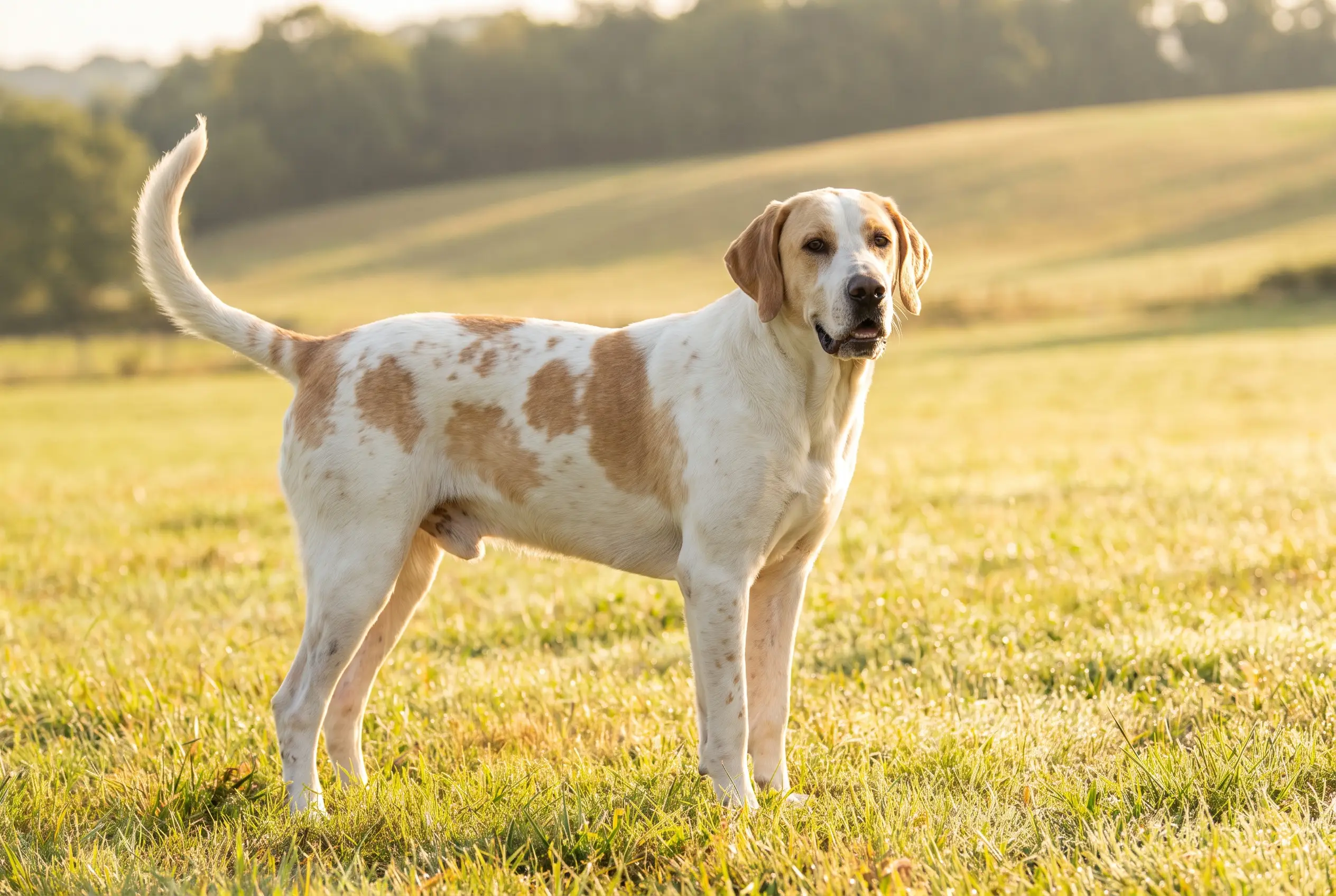
Grand Anglo-Français Blanc et Orange
White with lemon or orange patches, built to run big game all day — and the rarest of France's three Grand Anglo-Français hounds.
Vital stats
| Size | Large · 60–70 cm |
| Weight | 28–35 kg — breed literature; the standard sets none |
| Life expectancy | 10–13 years — breed literature, not survey data |
| Energy | High — bred to run big game across open country all day |
| Shedding | Low-moderate — short, thin coat |
| Coat | Short and not too thick · white with lemon or orange patches, never dark orange tending to red |
| Group | Scenthounds · Large-sized Hounds (FCI №324, Group 6) |
| Origin | France |
| FCI group | 6 — Scent hounds and related breeds · FCI 324 |
Breed traits
Friendliness
Care
Mind
The Grand Anglo-Français Blanc et Orange by the numbers
The Grand Anglo-Français Blanc et Orange facts owners search for most — price, lifespan, weight, shedding and colours, in one place.
Less common, so expect a waitlist and some travel to a reputable breeder — which pushes the price up. Ongoing costs run high — more food, bigger doses at the vet, and pricier insurance.
We don't quote a single figure: the real price swings with breeder, region, bloodline and health testing — and a rescue costs a fraction of a breeder's litter. Adopting is almost always the cheapest route.
Temperament
The standard gives this breed no dedicated temperament section the way many gundog standards do — it moves straight from coat colour to disqualifying faults. The closest it comes to describing character is the general appearance line, calling the dog 'quite a strong dog, powerful,' and a line near the end that disqualifies 'aggressive or overly shy dogs,' along with any dog 'clearly showing physical or behavioural abnormalities.' Read together, that reads like a standard written for judges assessing pack temperament in the ring, not for owners weighing a household pet, which tracks: these are hunting dogs kept in kennels with an équipage, not on a sofa. Breed literature outside the standard describes it as gentle and patient, particularly with children, and comfortable working alongside dozens of other hounds in the same pack — none of that is FCI text, so take it as secondhand.
Habits & quirks
More English in the head
The standard says so itself: it shows 'more English blood in his head than his tricolour colleague' — the Grand Anglo-Français Tricolore (FCI №322). That single line is the standard's own way of separating the two varieties by build, not only by colour.
Never too red
The permitted colours are white-lemon or white-orange, 'on condition that the orange is not too dark tending to red.' Black or red hair anywhere in the coat is named as a fault outright, a narrower colour rule than most FCI hound standards carry.
Grain in the tail
Near the tip, the standard allows 'a few longer and coarser, slightly offstanding hairs' that it compares to ears of grain — a small, specific detail written into an official FCI text, and something a judge is meant to look for rather than penalise.
A nose that isn't always black
Most FCI hound standards demand a black nose and fault anything else. This one permits 'black or orangy brown,' matched to the coat, with only a butterfly (partially unpigmented) nose counted as a fault.
Health
Breed literature reports hip and elbow dysplasia and the occasional ear infection, with no breed-wide health survey behind either claim, and the standard itself only carries the FCI's generic line about breeding from functionally and clinically healthy dogs. The 10–13 years usually quoted is breed literature too, not survey data. This is also the rarest of the three Grand Anglo-Français — France's stud book recorded no litters at all across three recent years — so the honest health question is about the breeding lines and how closely related they are, which matters more in a tiny population than any single condition.
Nutrition
| Exercise | Bred for grande vénerie: full days on horseback chasing deer or boar across open country, not a lead-walk breed. Breed literature calls it a hard worker that needs to live outdoors with real daily activity; there is no version of this dog that settles for apartment life. |
| Grooming | The coat is short and thin, and breed sources put brushing at once or twice a week. There is no de-shedding routine to plan around — the maintenance load here is genuinely light. |
| Training | Working packs are trained collectively, under a huntsman, to hunt as a unit rather than to sit and stay individually. The FCI text itself gives no guidance on obedience work; it only disqualifies 'aggressive or overly shy' temperaments. Because almost none are raised as single household pets, reliable literature on training one outside a pack is thin, and that gap is worth knowing before taking any plan on faith. |
| Health | Breed literature reports hip and elbow dysplasia and occasional ear infections, without a breed-wide health survey behind either claim. The standard's own health language is the FCI's generic boilerplate: both testicles descended in males, and only functionally and clinically healthy dogs with typical conformation used for breeding. |
Bred for grande vénerie — full days on horseback chasing deer and boar — this hound eats to a real workload, so let the bowl follow the season: far more when it's hunting hard, less when it's resting. Keep it lean and hard, with ribs you can feel under the short, thin coat, because a scenthound wears condition better than weight. As with any big, deep-chested dog, split the day's food into two meals and keep hard running clear of mealtimes — sensible standard caution for a hound of this size.
How much should I feed a Grand Anglo-Français Blanc et Orange? →
Puppy guide
Almost no Grand Anglo-Français Blanc et Orange is raised as a single household pet — these are pack dogs, kept outdoors with an équipage — so reliable guidance on rearing one alone is genuinely thin, and that gap is worth knowing before you take any plan on faith. If you do raise one outside a pack, socialise it early and widely, build a recall you can hold against a strong scent drive, and give the growing dog room and real activity rather than a life indoors. Get it used to handling and grooming young, even though the coat asks for very little.
Training
Working packs are trained collectively, under a huntsman, to hunt as a unit rather than to sit and stay as individuals, and the FCI text gives no obedience guidance at all — it only disqualifies aggressive or overly shy dogs. Because almost none are raised as single pets, trustworthy literature on training one outside a pack is scarce. Whatever you do, put recall first and keep it consistent against the hunting drive, keep sessions positive, and give the nose and legs the real daily work the breed was built around.
Life expectancy
Grand Anglo-Français Blanc et Orange hounds live 10–13 years — breed literature, not survey data. The 10–13 year span reconciles breed-literature sources that don't quite agree, and none of them sits on a breed-wide survey, so treat it as a guide. What keeps a big, active pack hound sound is plain: lean weight, clean ears, hips and elbows worth asking a breeder about, and the hours of real running it was made for. In so small a breeding population, a breeder who can talk honestly about how closely a litter is bred is worth as much as any figure.
Similar breeds
Breeds with a similar build and background — worth a look if this one isn't quite the fit.
Breeds that look like this
Common questions
What does 'Anglo-Français' mean, and is this the same dog as the Français Blanc et Orange?
'Anglo-Français' marks a specific cross: French pack hounds bred with English Foxhounds, mostly from the late 1800s onward, to add bone and drive to older French lines. This breed comes from crossing the French Billy with the Foxhound. The Français Blanc et Orange (FCI №316) wears the same white-and-orange coat but descends from the Billy alone, with no foxhound blood — same colours, different cross. France also keeps two other purely French hounds without the English cross: the Français Tricolore (FCI №219) and Français Blanc et Noir (FCI №220).
Does 'Grand' mean it's a bigger dog?
Not by size. It marks grande vénerie, the tradition of hunting large game such as deer and boar with a full mounted pack, as opposed to petite vénerie, hunting hare on foot with a smaller pack. The Anglo-Français de Petite Vénerie (FCI №325) is that smaller-format counterpart, standing well under this breed's 60–70 cm. 'Grand' describes the quarry and the hunt, not a size variety within the breed.
How does it differ from the other two Grand Anglo-Français?
By coat, and, per the standard, by a bit of head conformation. The Grand Anglo-Français Tricolore (FCI №322) carries three colours and, in this breed's own standard, less English influence in the head; the Grand Anglo-Français Blanc et Noir (FCI №323) is the same build in black and white. Numbers separate them too: France's kennel club logged zero litters of the Blanc et Orange in 2022, 2023 and 2024, while the Blanc et Noir registered a handful across those years and the Tricolore returned dozens in 2024 — making this the rarest of the three by a clear margin.
Does the Grand Anglo-Français Blanc et Orange shed a lot?
Moderately. The Grand Anglo-Français Blanc et Orange sheds a fair amount, steadily through the year with heavier seasonal patches. A weekly brush keeps most of the loose hair off your floors and clothes.
Is the Grand Anglo-Français Blanc et Orange hypoallergenic?
Not really. No dog is truly hypoallergenic, and the Grand Anglo-Français Blanc et Orange's shedding coat releases plenty of the dander that sets off allergies. If someone at home is allergic, this isn't the easiest breed to live with — spend time around one first.
Is the Grand Anglo-Français Blanc et Orange good with children?
They can be. The Grand Anglo-Français Blanc et Orange is reasonably sociable and can be good with children in the right home, especially when socialised early. Supervise around young kids and teach dog and child to respect each other.
Is the Grand Anglo-Français Blanc et Orange easy to train?
Reasonably. The Grand Anglo-Français Blanc et Orange is trainable with consistency and rewards, though it isn't the quickest study. Keep sessions short and positive, and be patient with the basics like recall.