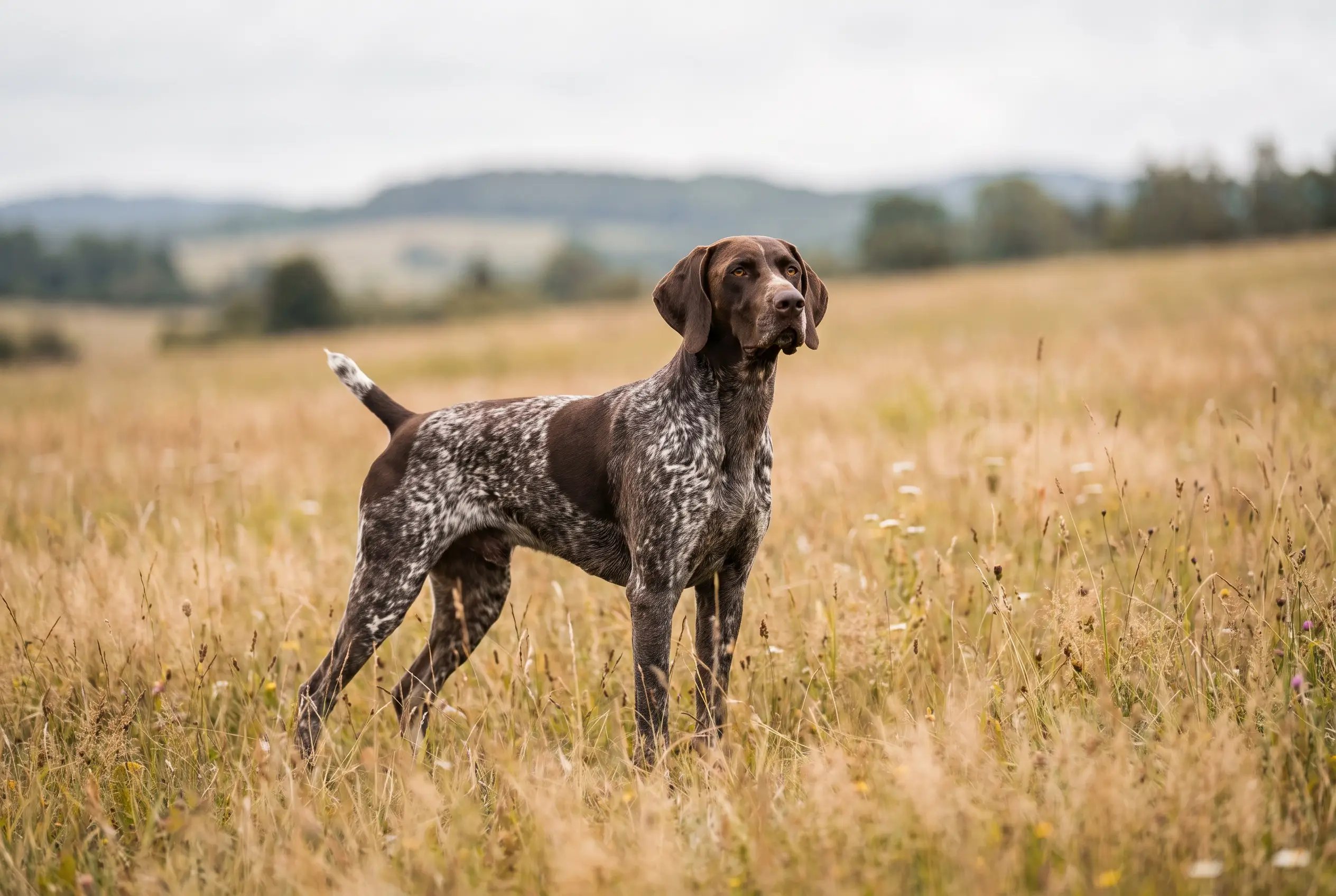
German Shorthaired Pointer
The all-terrain athlete — pointer, retriever and devoted shadow in one sleek package.
On these lists: Dogs for runners · Dogs for hunting · Truffle-hunting dogs · Dogs for hot weather · Dogs for hiking
Vital stats
| Size | Medium-large · 53–66 cm |
| Weight | 20–32 kg |
| Life expectancy | 12–14 years |
| Energy | Very high — 90–120 min/day |
| Shedding | Moderate, year-round |
| Coat | Short, dense · liver, liver & white ticked |
| Group | Sporting · FCI №119 / AKC |
| Origin | Germany |
| FCI group | 7 — Pointing Dogs · FCI 119 |
Breed traits
Friendliness
Care
Mind
The German Shorthaired Pointer by the numbers
The German Shorthaired Pointer facts owners search for most — price, lifespan, weight, shedding and colours, in one place.
Widely bred, so you can usually find a litter from a registered breeder without a long wait. Ongoing costs run high — more food, bigger doses at the vet, and pricier insurance.
We don't quote a single figure: the real price swings with breeder, region, bloodline and health testing — and a rescue costs a fraction of a breeder's litter. Adopting is almost always the cheapest route.
Temperament
Nineteenth-century German hunters wanted one dog for every job — pointing, retrieving, tracking, on land and in water — and bred exactly that. The wiring shows: a GSP is enthusiastic about everything, tireless in motion, and surprisingly cuddly once the tank is finally empty. It adores its people and simply assumes it is invited everywhere.
Habits & quirks
The frozen point
Mid-walk, mid-play, mid-anything: one paw lifts, the body locks, and somewhere a bird has been located.
Zoomies with intent
GSP sprints aren't chaos — they're laps, flown at racehorse speed with visible joy.
Lap dog delusion
Twenty-eight kilograms of muscle will fold itself onto your knees the moment you sit down.
Bird television
A window with pigeon traffic will be monitored for hours, tail ticking like a metronome.
Health
The German Shorthaired Pointer is a sound, athletic breed with no single dominant health problem, but two things are worth knowing. As a deep-chested dog it carries a real risk of bloat (gastric torsion), so feed calm, split meals, avoid hard exercise straight after eating, and learn the signs. And this is a serious working dog: without enough real exercise a GSP becomes stressed and destructive, which is its own kind of welfare problem. Buy from a breeder who health-tests their lines, keep the dog fit and lean, and give it the daily work it was built for.
Nutrition
| Exercise | Ninety minutes to two hours of real exercise daily — running, swimming, fetch — or the surplus energy gets spent on your furniture. |
| Training | Quick, willing learners who thrive on jobs; channel the prey drive early with rock-solid recall work. |
| Containment | Athletic, curious and scent-driven: a GSP needs a high, secure fence and should never be trusted off-lead near roads. |
| Health | A sound breed, but the deep chest brings bloat risk — feed calm, split meals and avoid exercise straight after eating. |
A GSP burns through fuel — this is a dog built to run all day — so feed enough to match ninety minutes to two hours of hard exercise while keeping it lean and racy, never heavy. Because the deep chest brings a bloat risk, split the food into calm, measured meals rather than one big bowl, and leave a gap around hard exercise rather than feeding right before or after. Weigh the meals, count treats into the total, and aim for ribs you can feel.
Puppy guide
A GSP puppy is friendly, clever and almost comically full of energy, and the first year is about channelling that rather than flattening it. Start reward-based training early — this breed learns fast and loves a job — and put real effort into recall, because the prey drive comes online young. Socialise widely, keep the developing joints in mind by not overdoing the hard exercise too early, and give the busy brain something to do every day. A GSP that learns good habits young is a wonderful companion; one left under-exercised writes its own agenda.
Training
GSPs are quick, willing learners that genuinely thrive on having a job, which makes them a pleasure to train — the work is aiming all that drive, not creating it. Channel the prey drive early with rock-solid recall, keep sessions varied and reward-based, and give the dog real outlets: gundog work, running, scentwork, dog sport. A GSP with a job is biddable and devoted; a bored one is fast, strong and inventive, and will find its own entertainment in your house.
Life expectancy
German Shorthaired Pointers live 12–14 years. The GSP is a healthy, long-lived breed for its size, and keeping one fit and lean is most of the secret — a well-exercised working dog at a good weight tends to stay sound for years. Buy from a breeder who health-tests, stay aware of bloat in this deep-chested breed, and give the dog the daily exercise that keeps both body and mind well.
Popular German mixes
Pointerdoodle
A high-energy, often lower-shedding cross that keeps the GSP's drive and love of work. Needs serious daily exercise and a job for its brain; coat and looks vary from pup to pup.
Similar breeds
Breeds with a similar build and background — worth a look if this one isn't quite the fit.
Breeds that look like this
Common questions
Are German Shorthaired Pointers good family dogs?
Excellent ones for active families — affectionate, playful and patient. Very young children may get bowled over by sheer exuberance, so supervise the toddler years.
How much exercise does a GSP need?
More than most people expect: 90 minutes to two hours daily, ideally including running or swimming. A quick lead walk around the block doesn't begin to touch it.
Can a GSP live with cats or small pets?
Sometimes, if raised together from puppyhood, but the prey drive is real and strong. Small pets like rabbits or birds are genuinely at risk and should never share free run of the house.
Does the German Shorthaired Pointer shed a lot?
Moderately. The German Shorthaired Pointer sheds a fair amount, steadily through the year with heavier seasonal patches. A weekly brush keeps most of the loose hair off your floors and clothes.
Is the German Shorthaired Pointer hypoallergenic?
Not really. No dog is truly hypoallergenic, and the German Shorthaired Pointer's shedding coat releases plenty of the dander that sets off allergies. If someone at home is allergic, this isn't the easiest breed to live with — spend time around one first.
Is the German Shorthaired Pointer easy to train?
Yes. The German Shorthaired Pointer is one of the more trainable breeds — quick to learn and keen to work with you, which makes reward-based training straightforward. Start early, keep it positive, and it picks things up fast.