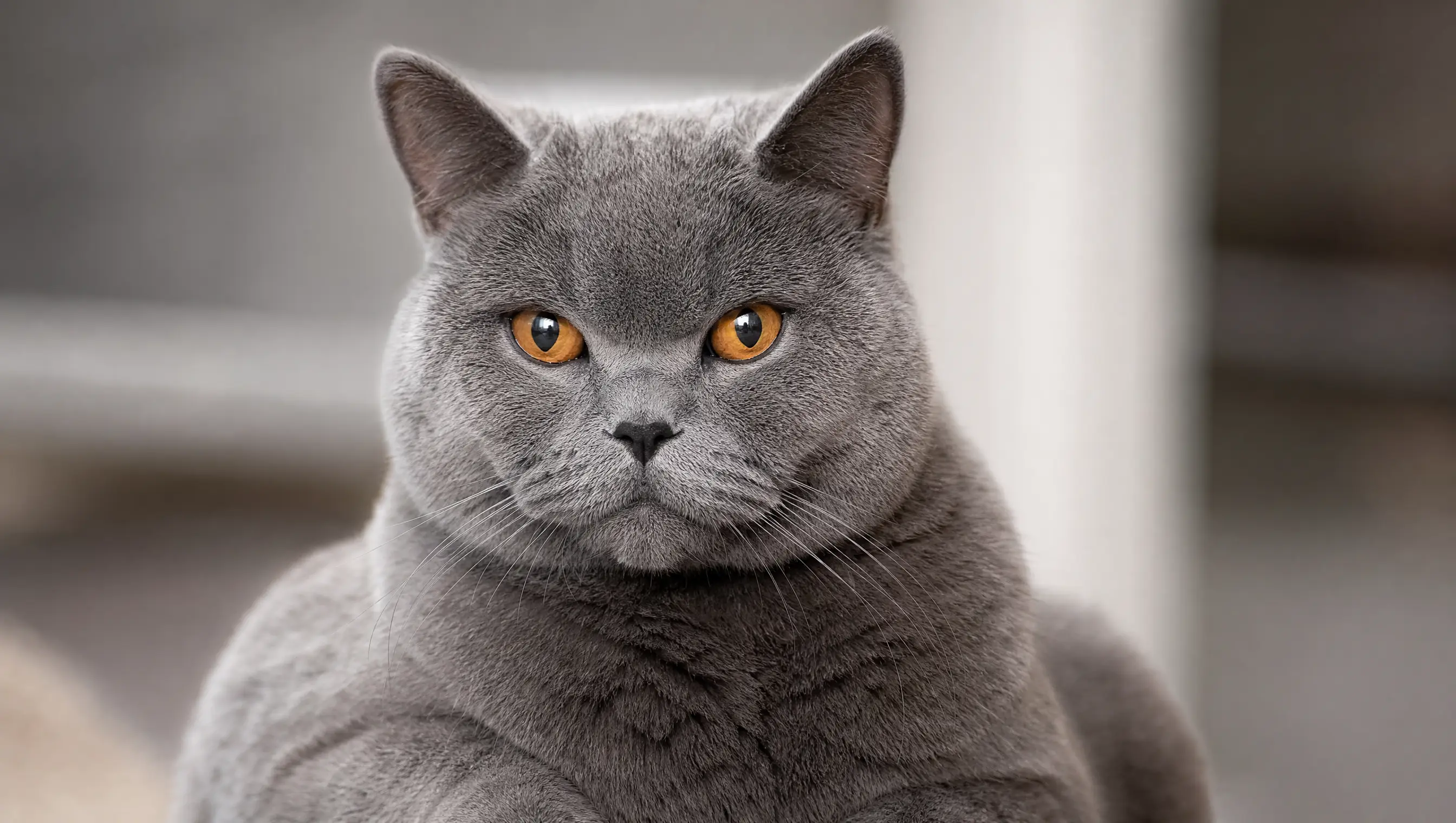
British Shorthair
Round eyes, round cheeks, and a firm four-on-the-floor policy about being picked up.
On these lists: Cats for apartments · Cats for first-time owners · Low-maintenance cats · Indoor cats · Cats for seniors
Vital stats
| Size | Medium to large · stocky, cobby build |
| Weight | 4–8 kg · toms often heavier |
| Life expectancy | 12–17 years |
| Energy | Low — placid and unhurried |
| Shedding | Moderate, heavier in spring and autumn |
| Coat | Short, dense, plush, no undercoat mat |
| Group | Shorthair |
| Origin | United Kingdom |
Breed traits
Friendliness
Care
Mind
The British Shorthair by the numbers
The British Shorthair facts owners search for most — price, lifespan, weight, shedding and colours, in one place.
Widely bred, so you can usually find a litter from a registered breeder without a long wait. Ongoing costs stay modest — it eats little and routine vet care sits at the lower end.
We don't quote a single figure: the real price swings with breeder, region, bloodline and health testing — and a rescue costs a fraction of a breeder's litter. Adopting is almost always the cheapest route.
Temperament
British Shorthairs are easygoing to the point of unflappable — undemanding, quiet, and slow to fluster. They tend to bond closely with the household but show it at a slight distance: near you rather than on you, and many actively dislike being scooped up or carried. Kittens play plenty, but adults settle into a dignified, low-key adulthood and are content to be left alone during the day, which makes them a reasonable fit for working owners. They're patient with sensible children and other pets, and they rarely make much noise. Just know that 'calm and food-motivated' slides easily into overweight if you free-feed.
Habits & quirks
Four on the floor
Most would rather sit beside you than be held; pick one up and you'll often get a polite wriggle to get down.
The teddy-bear coat
The dense, no-undercoat coat stands away from the body and feels like plush — but it packs a heavier seasonal shed than the short length suggests.
Quiet company
They talk little and keep to themselves for hours, then reappear to supervise dinner from a respectful distance.
Food radar
Genuinely food-driven and not very active — the pairing that makes this one of the easier breeds to accidentally overfeed.
Health
The British Shorthair is a sturdy, long-lived cat, and its biggest everyday risk is the simplest one: weight. A calm, sedentary cat with a real appetite slides into obesity if you free-feed, and that drags everything else down with it. On the inherited side, ask a breeder about HCM (heart) screening and, because the breed was rebuilt with Persian outcrosses, a clear PKD1 DNA test for polycystic kidney disease in the parents. One quirk worth knowing: the breed has an unusually high rate of blood type B, which matters for a transfusion or for breeding, so it's worth typing your cat.
Nutrition
| Grooming | A weekly comb is enough most of the year; step it up during the spring and autumn moults, when the thick coat drops in earnest. |
| Health screening | Ask a breeder for HCM (heart) screening and, given the Persian ancestry, a negative PKD1 DNA test for polycystic kidney disease in the parents. |
| Weight | Their placid nature plus a big appetite makes obesity the number-one everyday risk; measure meals, skip the free-feeding, and keep them moving with daily play. |
| Blood type | British Shorthairs have an unusually high rate of blood type B, which matters for breeding queens and any transfusion — worth typing before either. |
This is a carnivore built to eat well and move little, which is exactly the pairing that puts weight on. Measure meals instead of leaving a bowl down all day, count treats into the total, and aim for ribs you can feel under that plush coat but not see. Wet food helps with hydration and keeps a slow cat fuller on fewer calories. Portion control here isn't fussy — it's the single best thing you can do for a British Shorthair's health.
Kitten guide
A British Shorthair kitten plays hard, then grows into a calm, unhurried adult, so make the most of the busy stage. Socialise it early with people, sensible children and other pets while it's open to everything, and get it used to being handled, brushed and lifted, since many adults would rather keep four feet on the floor. Set up a safe indoor space with a scratching post and things to climb, start the vet and vaccination routine, and portion its food from the beginning: the weight habit is far easier to prevent than to reverse.
Training
British Shorthairs are easy, low-drama cats to live with. Litter training usually takes care of itself; the work that matters is keeping a naturally lazy cat active and steering that big appetite. Build in daily play — a wand toy, a chase, a puzzle feeder — so a sedentary cat still gets some exercise and the food has somewhere to go. Give it a sturdy scratching post and redirect it there from the sofa. Most dislike being scooped up, so don't force it; instead make the carrier a normal, unthreatening place with a few treats, and handling stays calm.
Life expectancy
British Shorthairs live 12–17 years. Weight is the lever that matters most. A British Shorthair kept lean, fed measured meals and screened for HCM and PKD lives a long, easy life at the top of that range. Let the appetite win and you shorten it — obesity is the everyday problem that drives the rest.
Similar breeds
Breeds with a similar build and background — worth a look if this one isn't quite the fit.
Common questions
Are British Shorthairs lap cats?
Usually not. They're affectionate but independent, and many prefer sitting next to you to being held. If you want a cat that curls up on you for hours, this isn't the most reliable pick.
Do they shed a lot for a shorthair?
More than the short coat implies. It's dense and plush, and it blows heavily twice a year in spring and autumn — a weekly comb, and more during those moults, keeps the loose hair down.
Why do British Shorthairs get overweight so easily?
They're calm, sedentary and strongly food-motivated all at once. Portion the food instead of leaving a bowl out, and build in daily play so a naturally lazy cat still gets some exercise.
Are British Shorthair cats hypoallergenic?
No cat breed is truly hypoallergenic, and the British Shorthair isn't one of the easier ones. The trigger is Fel d 1, a protein in a cat's saliva and skin that ends up on the coat during grooming and then spreads on loose hair and dander — and this breed sheds enough to move plenty of it around. If someone at home is allergic to cats, this is a hard breed to live with; spend real time around one first.
Are British Shorthair cats good with children?
Often, in the right home. The British Shorthair is reasonably sociable and can settle well with children who already know how to handle a cat gently. Give it high perches and a room the kids don't own, and introductions go far better.
How much grooming does a British Shorthair need?
A weekly comb is usually enough for the British Shorthair, with a second pass during a seasonal moult. That keeps loose hair off your furniture and cuts down on hairballs, since everything the cat doesn't shed onto the sofa it swallows while washing.
Stories featuring this breed
All stories →
If it fits: why cats sit in boxes
The cardboard box beats the forty-euro cat bed every time, and science has actually looked into why. Pressure, warmth, ambush logic — and the study where cats sat in squares that weren't even there.
Feeding a neutered cat without the weight gain
Neutering drops a cat's calorie needs by up to a third while its appetite climbs. Here's how to feed the same cat and keep it lean.