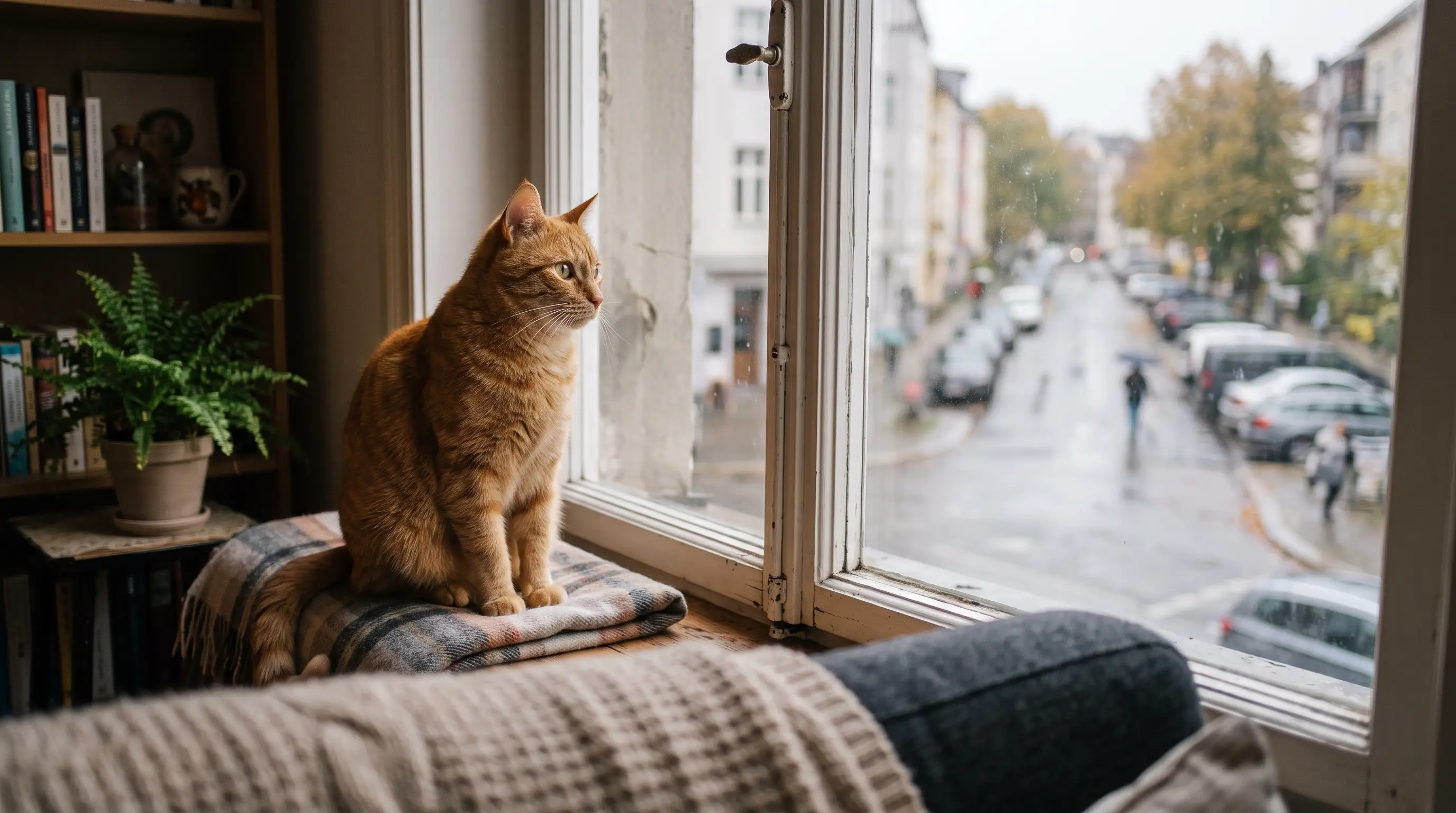
Do cats miss their owners? They even track the clock
Yes, cats notice your absence — and they measure it. In a Swedish experiment, cats greeted owners returning after four hours with far more purring and rubbing than owners returning after thirty minutes, which is hard to square with the theory that your cat merely registers the door opening. This piece covers what the evidence actually shows, the difference between missing you and clinical separation anxiety, and how to be away without leaving a mess behind — in either sense.
They notice — and they time it
The neatest evidence that cats register absence comes from Uppsala. In 2017, researchers at the Swedish University of Agricultural Sciences left cats home alone for either thirty minutes or four hours, then watched the reunions. The cats' behaviour during the wait barely differed — no pacing, no crying at the door. The greeting did: after four hours, cats purred more and stretched and rubbed against their owner more than after half an hour. The researchers' dry conclusion was that cats are affected by the duration of separation, which is a scientist's way of saying your cat knows the difference between you popping to the shop and you being gone all day.
What the cats did not do is equally telling: they didn't fall apart while alone. A cat's missing tends to be banked and paid out on your return — through the greeting, the shadowing from room to room, the pointed occupation of your lap — rather than spent on howling at an empty flat. If you want the wider evidence that there's a real bond underneath all this, the attachment science is laid out in do cats love their owners.
Missing you is normal. This is the line where it isn't
Some cats go past missing into genuine distress. A 2020 Brazilian survey published in PLOS ONE asked owners detailed questions about what their cats do home alone and found separation-related problems in roughly 13% of them — about one cat in eight. The signs were concrete: destroying things, crying or yowling for long stretches, urinating away from the tray, and in some cats a flat, apathetic withdrawal that owners easily misread as calm.
The same survey found the problem clustered: cats living with a single adult, cats with no toys, and cats with no other animal in the home were over-represented. None of that proves cause, but the pattern points somewhere useful — the cats struggling most were the ones whose entire social and sensory world walked out the door at 8am. A cat that scratches the sofa once while you're out is redecorating; a cat that reliably unravels every time you leave needs the environment fixed, and sometimes a vet's help ruling out pain or illness first.
Why the cool goodbye is honest
Here is the part dog people struggle with: a cat coping well alone is not proof it doesn't care. Dogs are cooperative pack hunters whose safety strategy is the group; a dog alone is a dog with a problem. Cats descend from a solitary hunter whose safety strategy is territory — and when you leave, you take yourself but you leave the territory, fully furnished with your smell. Your cat sits in the middle of a scent-map that says you live here, which is a very different experience of absence from a dog's.
So the calm goodbye is not indifference; it's a different architecture of attachment doing its job. The practical consequence runs the other way too: because territory is the anchor, a cat is usually better left in its territory with visits than taken out of it. That trade-off — sitter at home versus travelling with you versus a cattery — has its own guide in holiday or home.
Leaving well: the practical version
For a working day, a healthy adult cat with water, food, a clean tray and something to do needs nothing from you but a proper session of play before you go and after you're back. For a night away, most cats are still fine with provisions doubled and a boring, secure home. Past roughly twenty-four hours, someone should be coming in — not mainly for the food, but because trays fill, water fountains fail, and a cat that gets ill or trapped somewhere has nobody until you're back. Kittens, seniors and cats on medication shorten all of these numbers considerably.
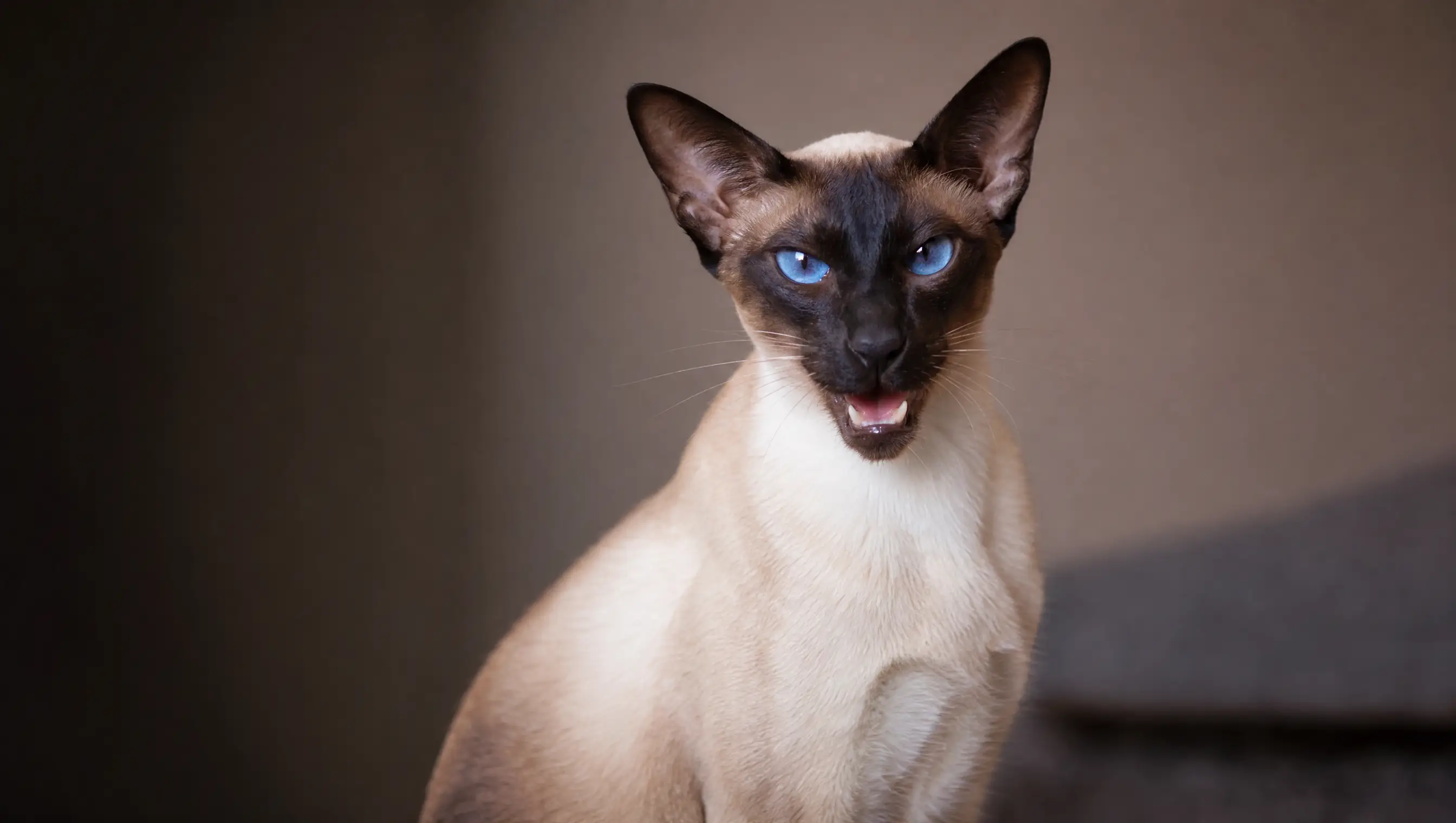
If you share your home with a velcro cat — a Siamese that narrates its day at you, a Ragdoll that follows you to the bathroom — plan absences with more care than the averages suggest: these are cats that have invested heavily in your company. Leave the radio low, a worn T-shirt in the favourite sleeping spot, food puzzles doing the entertaining, and the sitter briefed to play, not just pour.
Reading the reunion
The homecoming tells you how the absence went. Tail straight up, a chirruped trill, figure-of-eights around your ankles, and a cat that then gets on with its day: that absence was fine. The famous cold shoulder — the cat that greets your return by sitting three metres away, back half-turned — is renegotiation, not revenge; most cats run through it in an hour and end up on your lap. Cats don't do spite, and reading sulks into them mostly leads owners to punish a stressed animal.
What deserves attention is evidence from during the absence: a bald patch licked into a flank, a tray abandoned, food untouched, the neighbour mentioning hours of crying. Those are stress signals, not commentary, and the stress signs owners miss covers how to read them and when the first call is the vet rather than the behaviourist. A cat that punishes you for leaving does not exist. A cat that struggled while you were gone does — and it will tell you in body and habit, never in grudges.
Common questions
Do cats miss their owners when they're away?
Yes. In a 2017 Swedish study, cats greeted owners far more intensely — more purring, more rubbing — after a four-hour absence than after thirty minutes, which means they track how long you've been gone. Cats tend to express missing on your return rather than by pining while you're out.
Do cats get separation anxiety?
Some do. A 2020 Brazilian survey found separation-related problems in roughly 13% of cats — destructive behaviour, prolonged crying, urinating away from the tray, or flat withdrawal when left alone. It was more common in homes with one adult, no toys and no other animals. Persistent signs warrant a vet check first, then work on the environment.
How long can you leave a cat alone?
A healthy adult cat is generally fine for a working day, and most cope with one night given extra food, water and a clean tray. Past roughly twenty-four hours someone should come in — trays fill, water can fail, and an ill or trapped cat has no backup. Kittens, seniors and cats on medication need much shorter gaps.
Do cats get lonely?
They can, especially cats whose whole social world is one person and whose home offers little to do. The signs are under-stimulation as much as loneliness: over-grooming, over-sleeping, destructiveness, clinginess when you return. More play, food puzzles and window traffic help; a second cat is a serious step, not an automatic fix.
Will my cat forget me if I'm away for two weeks?
No. Cats hold long-term memories of people, and your home remains saturated with your scent while you're gone. Expect a renegotiation rather than a blank stare on your return — some cats greet you instantly, others take a wary hour or two before normal service resumes.
Why does my cat ignore me when I come home?
It's renegotiation, not revenge. Some cats respond to a disrupted routine by re-approaching you on their own schedule — sitting nearby, back half-turned, before returning to normal within hours. Cats don't hold grudges; if the aloofness comes with hiding, not eating or tray accidents, read it as stress rather than sulking.
More in Cats
Do cats love their owners? The kidnap experiment says yes
Science ran the same attachment test on cats that it runs on human infants, and 64% passed. What the secure-base test found, why one earlier study disagreed, and how a cat actually says it.
How cats choose their favourite person
It isn't whoever fills the bowl. The Swiss living-room study found one habit that predicts a cat's favourite better than food ever did — and the person who ignores cats has it by accident.
Cats know their names. They've decided not to answer
A Tokyo lab proved cats pick their own name out of a string of similar words — even from a stranger's mouth. What cats actually understand of what you say, and why the response is optional.
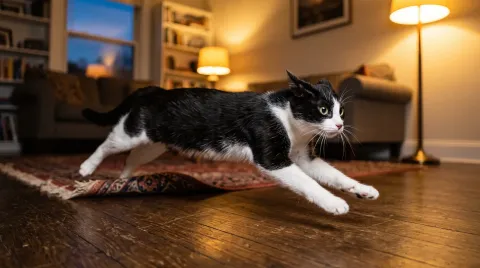
Zoomies: why your cat sprints through the house at 3am
The wall-of-death lap around the living room has a name, a mechanism, and a fix for the 3am edition. Why a predator that sleeps sixteen hours a day sometimes has to spend the surplus all at once.
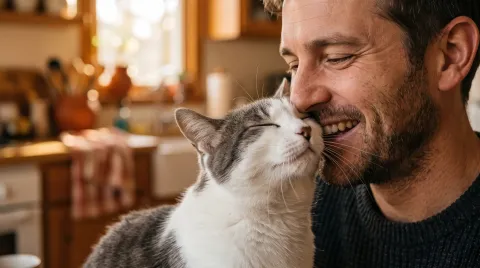
Headbutts and ankle rubs: what your cat marks you with
The forehead slam is called bunting, it comes with a chemical payload, and it's one of the biggest compliments a cat pays. What the glands are doing, what the group scent means, and when a rub is really an invoice.
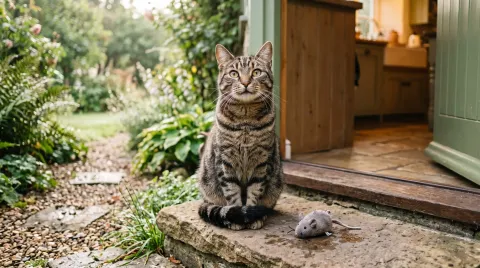
Why cats bring you dead animals
The mouse on the doormat is not a gift in any human sense, and the two leading theories disagree about what it is. What the delivery means, how to respond, and the honest arithmetic of what outdoor cats do to gardens.