Why are my cats fighting? How to restore the peace
When resident cats fall out, owners tend to ask what one cat did wrong. The better question is what changed — because cats that got along don't stop for no reason, and the reason is usually recent, findable, and fixable. This guide covers the fallouts that come out of nowhere: what actually breaks the peace, the emergency measures that stop things getting worse, and the staged reset that repairs a relationship far more reliably than waiting does.
First: is it actually a fight?
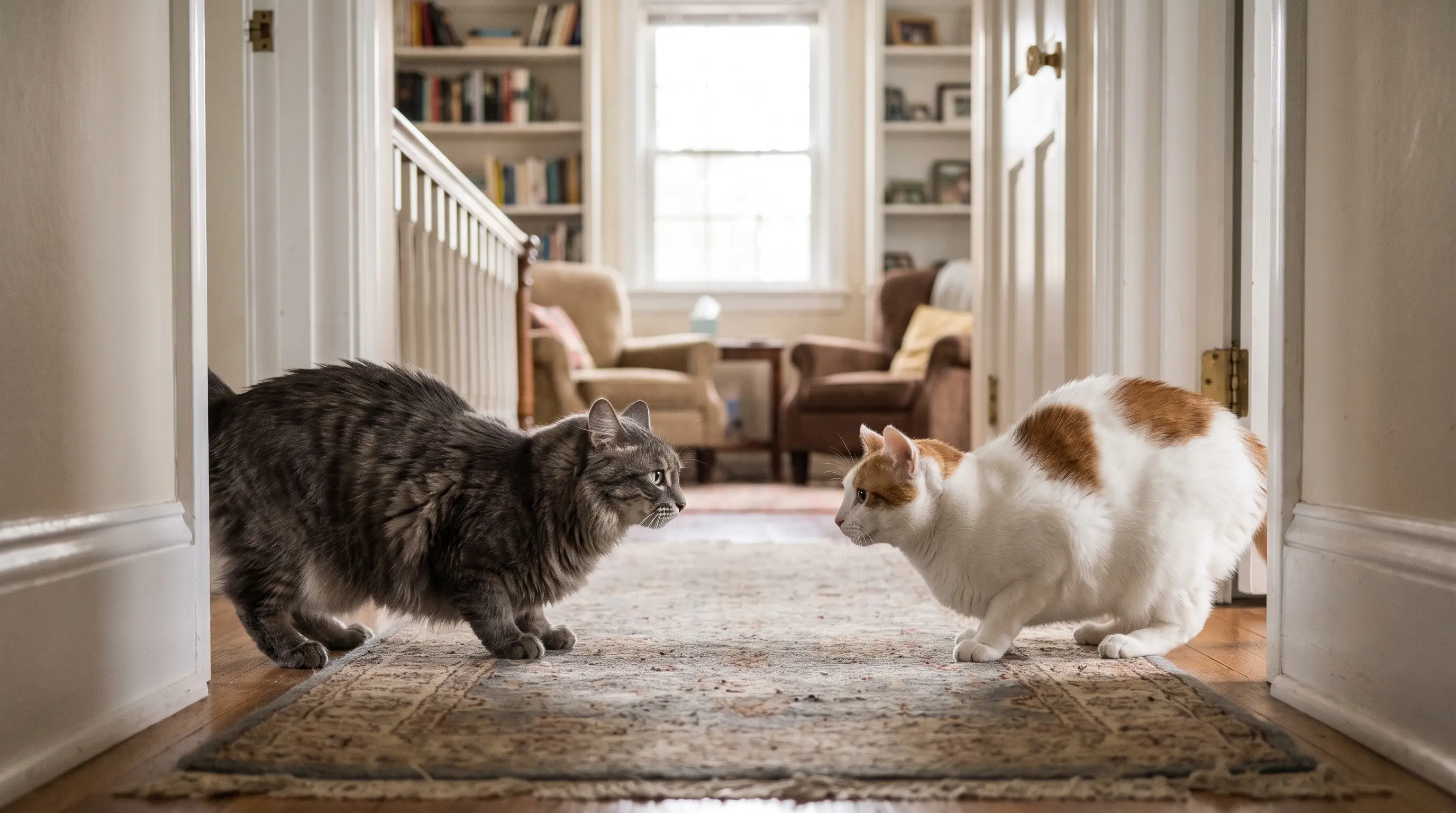
Cats that live together wrestle, chase and ambush each other for fun, and rough play reads as violence to a worried owner. Real fighting has different tells: screaming and hissing rather than silence, flattened ears and puffed fur, bites that hold instead of tap, tufts of fur on the floor, and — most telling — what happens afterwards, because play ends with two cats sharing a room and a fight ends with one cat gone. The full diagnostic is in playing or fighting. And know that most genuine cat conflict isn't loud at all: it's a cold war of staring, corridor-blocking, tray ambushes and one cat quietly ceding rooms. If one of your cats has started living on a wardrobe, the war is already on, whether or not you've heard it.
What breaks the peace
The usual suspects are specific. Social maturity: between two and four years old cats renegotiate relationships, which is how littermates who shared a basket become adults disputing a landing. The vet-visit effect: a cat comes home smelling of clinic and its housemate treats it as an intruder — scent is identity, and the hissing guide covers the quick fix of time apart and swapped bedding. One bad afternoon: redirected aggression, where a cat wound up by something unreachable — classically a strange cat outside the window — unloads on its housemate, can poison a relationship in minutes and keep it poisoned for months, because both cats now expect attack. Pressure on resources: a new pet or baby, a house move, or simply too few trays, bowls and beds for the number of cats turns housemates into competitors. And occasionally the trigger is that one cat is unwell — illness changes smell and behaviour, and the healthy cat reacts to the difference. A sudden fallout with no visible cause earns the sick-cat check before the behaviour plan.
Stop the bleeding: the emergency measures
First, retire the worst advice in cat ownership: they will not "work it out themselves". Every fight rehearses the relationship both cats now expect, so letting them fight entrenches exactly what you want gone. If there are injuries, real terror, or a cat that has stopped eating or using the tray, separate them fully — different rooms, own resources — and treat it as a cooling-off period, not a punishment. Below that threshold, manage the geography: break the sightlines where the staring happens, add routes past choke points (a shelf, a second door), and split resources so nothing is worth contesting — one tray, bowl and bed per cat plus a spare, spread apart. Don't punish either cat, including the "aggressor"; the bully in a cat conflict is usually the more anxious animal, and punishment raises the anxiety driving the whole show. If urine starts appearing on walls during a standoff, that's the same conflict speaking — see why is my cat spraying.
The reset: reintroduce them like strangers
A broken cat relationship is repaired the same way a new one is built — with a staged reintroduction that treats the pair as if they'd never met, because as far as their expectations go, they haven't: each now predicts attack, and the protocol's job is to overwrite that prediction with boring, pleasant repetition. Separate fully, swap scents daily (bedding, a cloth rubbed on cheeks), feed on opposite sides of a closed door so good things happen at the smell of the other cat, then graduate to visual contact through a gap or screen at a distance where both can eat calmly, then to short supervised sessions that end before anyone stiffens. The pace is set by the tenser cat, and days-per-stage is normal — the full protocol is in introducing cats. Meanwhile audit the household against the signs of a stressed cat; a reintroduction into the same shortage that caused the war doesn't hold.
If the peace won't hold
Some pairs need more than protocol. If a properly run reintroduction stalls — a cat that can't eat within sight of the other after weeks, injuries recurring, one cat's life shrinking to a single room — bring in your vet: first to rule out pain or illness feeding the tension in either cat (the checklist in why is my cat aggressive applies to both parties), then for a referral to a qualified behaviourist, and sometimes for anti-anxiety medication that gives the frightened cat enough slack for the training to work. And the honest endpoint, said plainly: a small number of cat pairs are genuinely incompatible, and for them the kindest outcome is permanent separation within the home or, at the last resort, rehoming one cat to a single-cat household where it can stop fighting a war. That outcome is rare, it isn't failure, and it beats years of mutual dread — but it belongs at the end of the list, after the reset has had a real chance to work.
Common questions
Why are my cats suddenly fighting?
Something changed: one cat hit social maturity (2–4 years) and renegotiated the relationship, one came home smelling of the vet, a redirected-aggression episode — classically triggered by a strange cat outside the window — poisoned things in an afternoon, or new pressure on territory and resources turned housemates into rivals. A sudden fallout with no visible trigger also warrants a vet check, since illness in one cat can set it off.
How do I get my cats to get along again?
Separate them fully, then reintroduce them in stages as if they'd never met: daily scent swapping, feeding on either side of a closed door, then visual contact at a distance, then short supervised sessions that end before tension rises. The tenser cat sets the pace. Fix the resource math at the same time — one of everything per cat plus a spare, spread out.
Should I let my cats fight it out?
No. Cats don't resolve disputes by fighting to a settlement — each fight rehearses the hostility both cats now expect, so 'letting them work it out' entrenches the war. Interrupt calmly (a noise, a cushion between them — never hands), separate, and fix the cause. Repeated real fights mean a full separation and staged reintroduction.
How do I know if my cats are playing or fighting?
Play is mostly silent, roles swap (chaser becomes chased), claws stay in, bites don't hold, and afterwards the cats stay near each other. Fighting comes with hissing or screaming, flattened ears, puffed fur, bites that grip, fur on the floor — and afterwards one cat disappears. The aftermath is the most reliable tell.
Why is my cat attacking my other cat after the vet?
The returning cat smells of the clinic instead of the household, and to its housemate scent is identity — so it's briefly treated as a stranger. Keep them apart for a few hours after a vet visit and swap bedding between them so the group scent rebuilds before they share a room. If the hostility outlasts a day or two, run a short staged reintroduction.
Will my cats ever get along again?
Usually, yes — most fallouts respond to separation plus a properly paced reintroduction, though rebuilding can take weeks and the relationship may settle into polite coexistence rather than cuddling. A small minority of pairs are genuinely incompatible; for them, permanent separation or rehoming one cat is kinder than years of standoff — but that's the last resort, not the forecast.
More in Cats
Why is my cat spraying? What it means and how to stop it
Spraying isn't a litter-box failure — it's a message about territory, written in urine. How to tell it from peeing, what's behind it, and the fixes that hold.
Why is my cat aggressive? Causes and how to calm it
Cat aggression isn't a personality — it's a diagnosis with about six usual suspects, and each one has a different fix. Work through them in order and the biting usually explains itself.
Why do cats hiss? What it means and what to do
A hiss is not an attack — it's the thing a cat does to avoid one. What the sound actually is, what triggers it, and why the polite answer is always to back off.
How neutering changes cat behavior — and what it won't fix
Neutering deletes the hormone-driven behaviours — the roaming, the spraying, the 3am opera — and touches almost nothing else. What changes, what doesn't, and when.
Why your cat bites you mid-stroke
Purring one second, teeth the next — petting-induced aggression is the most misread move in cat ownership. The warnings arrive earlier than you think, and the fix is counting, not forgiveness.
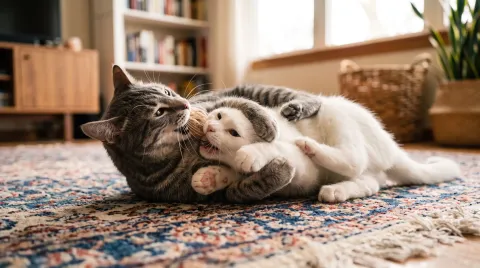
Are my cats playing or fighting? The five reads
Wrestling, neck bites, bunny kicks and thundering chases — most of it is play, some of it isn't, and the difference is visible in five places. What to check, when to step in, and how to step in without getting shredded.