Why cats bring you dead animals
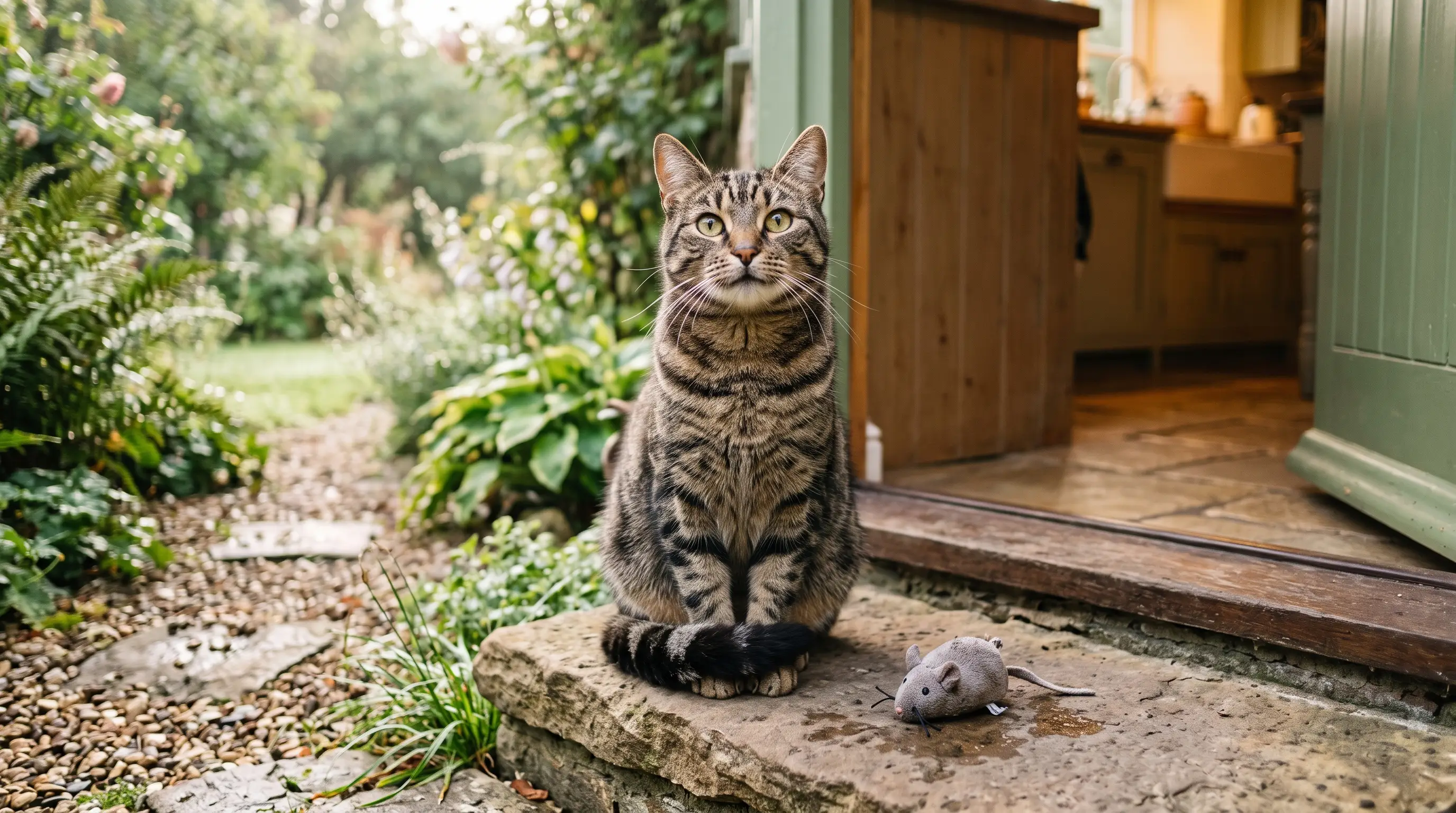
The classic scene: a proud trill at the back door, a small corpse on the mat, and a cat plainly expecting a response. What that delivery means has two serious explanations — the teaching instinct of a mother cat, and the safe-larder habit of a cautious hunter — and the honest answer is that nobody has settled it. What is settled: it isn't malice, it isn't a misfired present in the human sense, and punishing it teaches nothing. Here's what's actually going on, what to do at the doormat, and the part most cat content skips — what all this hunting adds up to outside.
Theory one: you are a very large, very hopeless kitten
The teaching account starts with how hunting is passed on. A mother cat runs a structured course: first she eats prey away from the nest, then brings dead prey back for the kittens, then injured prey for them to finish, then takes them hunting. Bringing food to the incompetent is deep maternal wiring — and it's often noted that enthusiastic deliverers are disproportionately female, including spayed females with no kittens to school. On this reading, the mouse on your mat is the first lesson of a curriculum you are failing: you never eat what you're given, you never improve, and the course keeps restarting.
It's a charming theory with a real mechanism behind it, and it may well be part of the truth. But it has gaps — plenty of males deliver too, and cats bring prey to houses with no audience at all. Which points at the second account.
Theory two: the safe larder
A solitary hunter in the wild has a storage problem: eating a catch on the spot means exposure — to rivals, to bigger predators, to losing the rest. Wild cats routinely carry prey to a secure spot before eating or caching it. Your home is your cat's secure core territory; the doormat, the kitchen floor and occasionally your pillow are simply the strong-room. On this reading the cat isn't giving you anything — it's banking the catch where the catch is safest, and the fact that you live in the vault is incidental.
The hunger wrinkle supports this: well-fed cats hunt nearly as much as hungry ones, because the hunting programme and the appetite programme run on separate circuits — a fact anyone who has watched a fed cat stalk a bottle cap already knows. The chase is triggered by movement, not need; what changes with a full stomach is only what happens after the pounce. A full cat with a fresh mouse has a logistics question, and you live at the answer.
What to do at the doormat
Respond boringly. No shrieking, no praise, no chase around the kitchen — any big reaction, positive or negative, makes the delivery memorable, and memorable behaviours repeat. Calmly remove the animal (a bag over the hand, then inverted), dispose of it outside the cat's sight, and move on. Never punish: the cat is running ancient software, punishment connects the misery to you rather than to the mouse, and a stressed cat is a worse housemate in a dozen other ways — the fallout patterns are in the stress signs owners miss.
If the animal is still alive: cat in another room first, then assess. A stunned bird that flies off was lucky; anything punctured needs a wildlife rescue rather than a hopeful release, because cat mouths carry bacteria that make even small punctures lethal within days. And redirect the drive at home — the hunting sequence your cat is trying to complete works just as well on a wand toy that dies theatrically and gets "eaten" as a treat. A cat that finishes its hunt indoors delivers fewer corpses. The mechanics of that daily fake hunt are the same ones that fix the 3am problem in the zoomies guide.
The part cat people skip: the arithmetic outside
Here is the uncomfortable half of the story. The corpses you see are a fraction of the kills: prey-camera studies consistently find cats bring home only a minority of what they catch — the rest is eaten or abandoned in the field. Multiply a modest per-cat tally by the tens of millions of owned and feral cats in Europe and you get predation pressure that conservation bodies treat as a serious problem for garden birds, small mammals and reptiles, particularly in spring when fledglings are on the ground.
This is not a reason to hate cats; it's a reason to manage them. It's also the same pressure that runs in reverse in our wild-cat coverage: the European wildcat is threatened partly by the sheer number of domestic cats in its landscape — through competition, disease and hybridisation that dilutes the wild gene pool. The predator on your doormat is the same animal in both stories. That's rather the point of owning one thoughtfully.
Cutting the body count without a cage
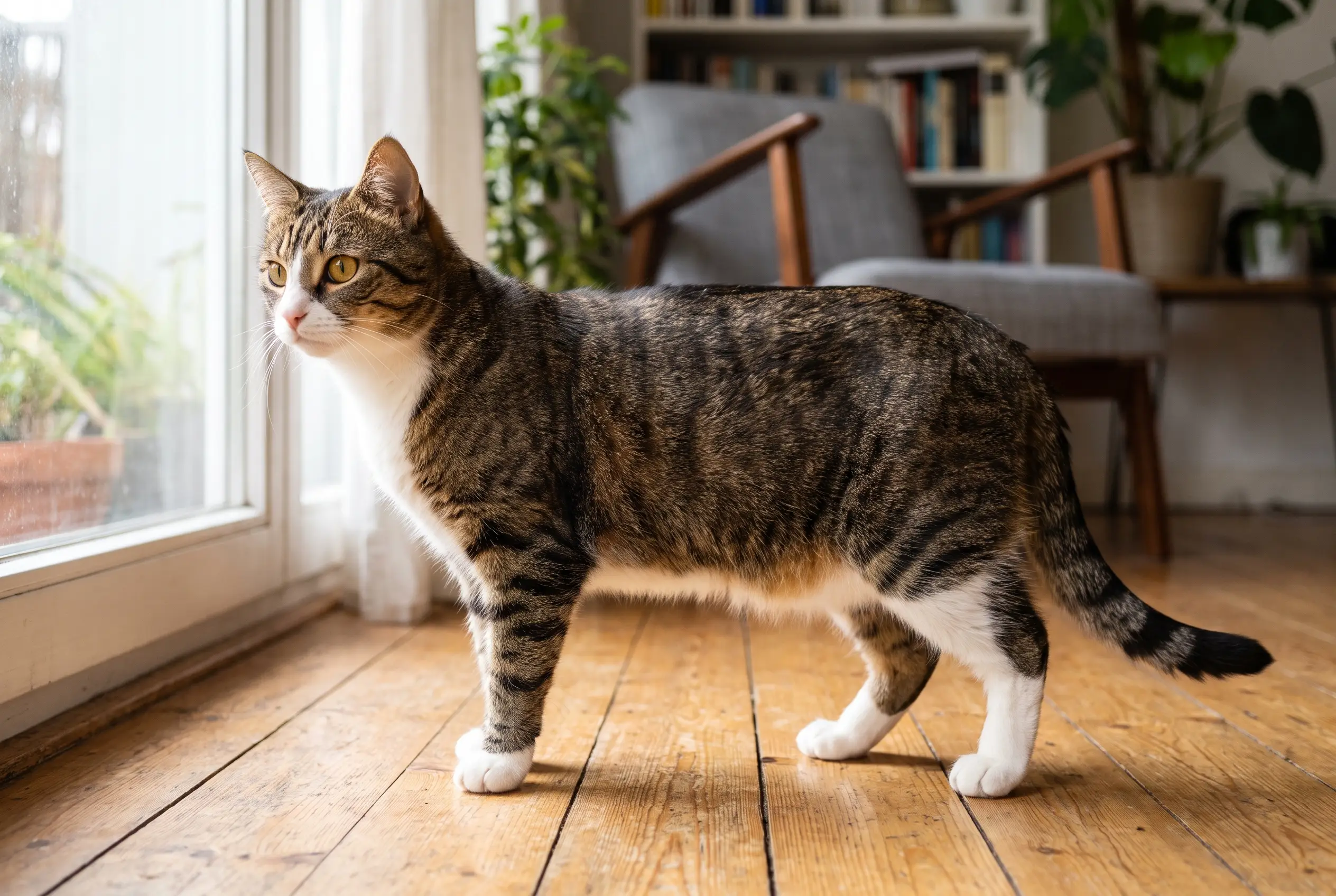
The evidence on what works is surprisingly cheerful. A brightly coloured collar cover (the rainbow-ruff type) makes an ambushing cat visible to birds and cuts bird kills dramatically in trials; a bell helps less than people assume but still helps. Two behavioural levers tested in a 2021 Exeter study worked without restricting the cat at all: a high-meat diet and five to ten minutes of daily hunting-style play each reduced prey brought home by roughly a third. Keeping cats in at dawn and dusk — peak hunting hours — protects wildlife at the cost of a grumble, and spring fledgling season is the time to be strictest.
The full indoor/outdoor question — traffic, disease, lifespan, and the catio middle ground — deserves its own honest treatment, and this cluster's door-dasher guide will take it on. For now, the practical position: love the predator, feed it well, play the hunt out of it daily, dress it like a small clown for the birds' benefit, and read the doormat delivery as what it is — a wild animal's logistics, executed with total sincerity, in a world it didn't choose. The European Shorthair on your step descends from ten thousand years of exactly this.
Common questions
Why do cats bring you dead animals?
Two serious explanations exist and both may be true: the maternal teaching instinct (mother cats bring prey to kittens as hunting lessons, and you are a hopeless pupil) and the safe-larder habit (a solitary hunter carries its catch to the safest spot in its territory — your home — before eating or storing it). It is not malice and not a human-style gift.
Why does my cat bring me toys at night?
It's the same delivery behaviour running on a substitute prey. Cats that can't hunt outside often carry a favourite toy to their person, sometimes announcing it with the distinctive loud carrying-cry. It usually means the hunting sequence wants completing — a daily play session that ends in a caught, 'killed' toy gives it somewhere to go.
Should I punish my cat for bringing dead animals?
No. The behaviour is ancient instinct, not disobedience, and punishment only connects the fear to you — the cat cannot join the dots to the mouse. Respond boringly: remove the animal calmly out of sight, no drama in either direction, and redirect the drive into daily hunting-style play indoors.
What should I do if my cat brings in a live animal?
Put the cat in another room first. A stunned, unmarked bird can be released once it recovers; any animal that has been punctured needs a wildlife rescue centre, because bacteria in cat mouths make even small bite wounds fatal within days if untreated. Handle with gloves or a towel, keep it dark and quiet, and don't offer food or water.
How do I stop my cat killing birds?
The tested toolkit: a brightly coloured collar cover cuts bird kills sharply by making the ambush visible; a bell helps somewhat; a high-meat diet and five to ten minutes of daily hunting-style play each reduced prey brought home by about a third in a 2021 University of Exeter study; and keeping the cat in at dawn, dusk and during spring fledgling season protects wildlife at peak risk hours.
Do well-fed cats still hunt?
Yes. Hunting and hunger run on separate circuits — the chase is triggered by movement, not appetite — so a full cat still stalks and kills; it just eats less of what it catches. This is why feeding alone never stops hunting, though a high-meat diet has been shown to reduce it.
More in Cats
Do cats love their owners? The kidnap experiment says yes
Science ran the same attachment test on cats that it runs on human infants, and 64% passed. What the secure-base test found, why one earlier study disagreed, and how a cat actually says it.
Do cats miss their owners? They even track the clock
Cats greet you harder after four hours away than after thirty minutes — they know how long you were gone. What missing looks like in a cat, when it tips into separation anxiety, and how to leave well.
How cats choose their favourite person
It isn't whoever fills the bowl. The Swiss living-room study found one habit that predicts a cat's favourite better than food ever did — and the person who ignores cats has it by accident.
Cats know their names. They've decided not to answer
A Tokyo lab proved cats pick their own name out of a string of similar words — even from a stranger's mouth. What cats actually understand of what you say, and why the response is optional.
Zoomies: why your cat sprints through the house at 3am
The wall-of-death lap around the living room has a name, a mechanism, and a fix for the 3am edition. Why a predator that sleeps sixteen hours a day sometimes has to spend the surplus all at once.
Headbutts and ankle rubs: what your cat marks you with
The forehead slam is called bunting, it comes with a chemical payload, and it's one of the biggest compliments a cat pays. What the glands are doing, what the group scent means, and when a rub is really an invoice.