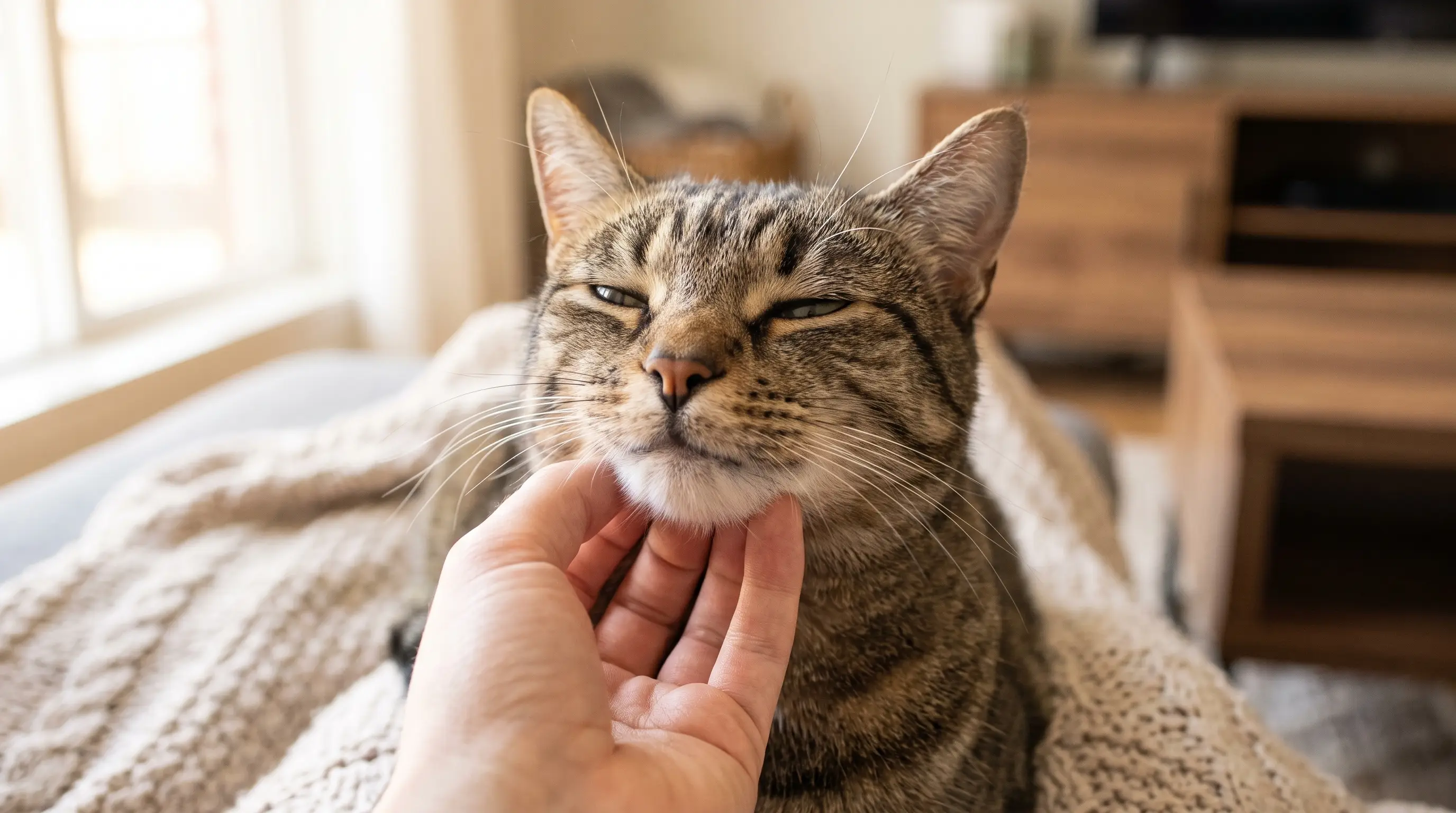
Why do cats purr? It's not always happiness
A purring cat is usually a happy cat — but not always. Cats also purr when they are frightened, injured, in labour and even close to death, which means the purr is not a simple happiness meter. It is closer to a self-soothing tool, and sometimes a request aimed squarely at you. Here is how the sound is actually made, why a cat might purr on the vet's table, and how to read a purr in context rather than at face value.
How a cat actually purrs
For decades the accepted explanation was neural. A dedicated oscillator in the cat's brain sends a rhythmic signal — roughly 25 to 150 times a second — to the muscles of the voice box, which open and close the gap between the vocal folds. Air passing through gets chopped on both the in-breath and the out-breath, and that is why a purr, unlike a meow, runs unbroken while the cat keeps breathing. It is one continuous sound because the cat is powering it in both directions.
In 2023 a study led by voice scientist Christian Herbst in Vienna complicated that neat picture. Working with larynxes from cats, the team found the vocal folds carry pads of connective tissue that can vibrate at very low frequencies on their own, rather like the vocal fry a person can make at the bottom of their range — no rapid brain signal required. That would help explain how an animal the size of a house cat produces a note so low. The two ideas are not mutually exclusive, and the honest position is that the mechanism is still being worked out. What is clear is that purring is unusual enough that we are only now pinning down how it works.
Purring isn't only happiness
The single most useful thing to know about purring is that it is context-dependent. Cats purr when they are content on your lap, yes — but they also purr when they are stressed at the vet, when they are hurt, while giving birth, and sometimes in the last hours of life. A behaviour that shows up across states that pleasant and that grim cannot simply mean "I am happy."
The thread that connects them is self-soothing. A purr appears to be a way a cat calms and steadies itself, which is why it turns up under pressure as readily as in comfort. So a purr is only as informative as the body around it. Pair it with what the rest of the cat is doing — a loose body, slow blink and relaxed ears say contentment; a tucked posture, flattened ears and wide eyes say the cat is coping with something, and the purr is part of the coping. We walk through the difference in the signs a cat is stressed.
The purr that's aimed at you
Some purrs are pointed. In a 2009 study at the University of Sussex, Karen McComb and colleagues found that many house cats embed a second, much higher-pitched cry inside the low rumble of the purr when they want something — usually food, usually from the one person they live closely with. Acoustically, that hidden cry sits in a range close to a human baby's cry, and when people were played the recordings they rated these "solicitation purrs" as more urgent and less pleasant than an ordinary contented purr.
In other words, the cat has found a frequency we are wired to respond to and folded it into a sound we already like. The pre-dawn purr on your chest, then, is affectionate and manipulative at the same time — a genuine bit of closeness with a request threaded through it. Cats that live one-to-one with an owner seem to develop it most, presumably because there is one specific human to train.
Do purrs heal? What's real and what's folklore
You will often read that a cat's purr heals its own bones, and the claim has a real kernel wrapped in a large leap. The kernel: purrs fall in a low band, roughly 25 to 150 Hz, and some laboratory work on humans and other animals suggests vibration in similar low-frequency ranges can encourage bone density and tissue repair. The leap: therefore cats purr to heal themselves.
There is no study showing that a cat's own purring mends its bones, and treating the "healing frequency" idea as established fact overstates what anyone has actually shown. What is genuinely evidenced is gentler and still worthwhile — purring is calming for the cat and, for a lot of people, soothing to be near. Enjoy that for what it is, and file the bone-healing story under appealing hypothesis rather than settled science.
When a purr should make you look closer
Because purring can be self-soothing, it is exactly the sound a cat in trouble might make — and it is easy to be reassured by it when you should not be. A cat that is purring while it hides, breathes hard, refuses food or holds an injured leg is comforting itself, not telling you it is fine.
So watch the company the purr keeps. A purr alongside laboured or open-mouthed breathing, a purr from a cat that has gone quiet and stopped eating, a purr from an animal that is clearly hurt — none of those are all-clears, and all of them are reasons to call your vet rather than to relax. The rule of thumb is simple: read the whole cat, and never let a purr talk you out of a vet visit the rest of the picture is asking for.
Common questions
Why do cats purr?
Cats purr for several reasons, and contentment is only one of them. A purr appears to be a self-soothing mechanism, which is why cats also purr when stressed, injured, giving birth or even dying. Some cats also purr to ask for food, and mother cats and kittens purr to stay in contact. Read the purr alongside the cat's body language rather than as an automatic sign of happiness.
Do cats only purr when they are happy?
No. Cats purr when they are relaxed and content, but they also purr when frightened, in pain, at the vet or in labour. The common thread seems to be self-soothing, so a purr is only meaningful in context. A loose, slow-blinking cat is happy; a tense, hiding, hard-breathing cat that is purring is coping with something and may need help.
Why does my cat purr when I stroke it?
Stroking a relaxed cat mimics the comfort and safety it felt as a kitten, and purring is how it signals and reinforces that calm, content state. If the rest of the cat is loose and its eyes are half closed, that purr is genuine contentment. Purring that comes with a tense body or a suddenly lashing tail can instead be a sign it has had enough of being touched.
Do cats purr when they are in pain?
Yes. Cats often purr when hurt, ill or stressed, which is thought to be a way of self-soothing rather than a sign they feel fine. This is why a purr should never reassure you out of a vet visit if the cat is also hiding, off its food, breathing hard or clearly injured. Judge the situation by the whole animal, not the purr alone.
Is a cat's purr actually healing?
There is a real but overstated claim here. Purrs sit in a low frequency band, and some lab studies suggest similar low-frequency vibration can aid bone and tissue in humans and animals — but no study shows a cat's own purr heals its bones. What is genuinely supported is that purring is calming for the cat and often soothing for the people near it. Treat the bone-healing idea as an unproven hypothesis.
Why does my cat purr loudly in the morning?
That is very likely a solicitation purr — a purr with a higher-pitched cry hidden inside it that cats use to ask for something, usually food. Research has found this hidden cry sits close to the frequency of a human baby's cry, which makes it hard to ignore. Cats that live closely with one person tend to develop it most, aiming it at the human most likely to fill the bowl.
Why is my cat purring constantly?
Some cats are simply loud, frequent purrers, and a constant purr in a loose, slow-blinking cat that kneads your lap is nothing but comfort. The purr worth a closer look is the one that keeps company with other changes: a cat that purrs while hiding, refusing food, sitting tense or breathing hard is soothing itself, not telling you it is fine. The change matters more than the amount — a quiet cat that suddenly purrs around the clock deserves a vet call.
More in Cats
Do cats love their owners? The kidnap experiment says yes
Science ran the same attachment test on cats that it runs on human infants, and 64% passed. What the secure-base test found, why one earlier study disagreed, and how a cat actually says it.
Do cats miss their owners? They even track the clock
Cats greet you harder after four hours away than after thirty minutes — they know how long you were gone. What missing looks like in a cat, when it tips into separation anxiety, and how to leave well.
How cats choose their favourite person
It isn't whoever fills the bowl. The Swiss living-room study found one habit that predicts a cat's favourite better than food ever did — and the person who ignores cats has it by accident.
Cats know their names. They've decided not to answer
A Tokyo lab proved cats pick their own name out of a string of similar words — even from a stranger's mouth. What cats actually understand of what you say, and why the response is optional.
Zoomies: why your cat sprints through the house at 3am
The wall-of-death lap around the living room has a name, a mechanism, and a fix for the 3am edition. Why a predator that sleeps sixteen hours a day sometimes has to spend the surplus all at once.
Headbutts and ankle rubs: what your cat marks you with
The forehead slam is called bunting, it comes with a chemical payload, and it's one of the biggest compliments a cat pays. What the glands are doing, what the group scent means, and when a rub is really an invoice.